
At Bayview Church of Christ, Fresh Food Fuels Creativity

December 9, 2025

On a sunny Thursday afternoon in the Bayview, Danielle scopes out tables of fresh produce at the Bayview Church of Christ neighborhood food pantry. She’s bringing them home to her mom, who she’s been caring for full-time for the last 13 years. The weekly visits to this pantry, part of the San Francisco-Marin Food Bank’s Neighborhood Food Network, have become woven into their daily life — even sparking Danielle’s creativity. 

Finding Creativity Where You Can 

Danielle is a passionate, professional artist, but being a caretaker means she doesn’t always get to her work. When she can’t find the time, she creates with what she has: the food she cooks for her mom, much of which comes from the Bayview Church of Christ food pantry. Eggs on potatoes with tomato, carrot ginger soup, grapes and pears arranged on a plate. When her mom is delighted by one of these artfully arranged meals, Danielle takes a picture. 

Danielle estimates she’s taken about 500 photos by now. “Those pictures only happen when she wants a picture,” she explains. “I only take those pictures when she says, ‘Ooh, I like this. Let me take a picture.'” 

She’s even turned these pictures into an art exhibit, showing them both with fellow artists and in a solo show. 

The food from the pantry has brought unexpected joy to this family: ingredients that become art, and meals that spark happiness. It has also helped ease some of the burdens. 

Between managing her mom’s Alzheimer’s and trying to afford life in San Francisco, there’s a lot to juggle. So when Danielle noticed the pantry opening in 2023 while walking her dog, she signed right up. She was grateful she wouldn’t have to choose between groceries and paying for other essentials. 

“It’s one less thing I have to worry about,” Danielle says. “Financially, every little part matters and counts.” 

A Partnership That Changed Everything 

Bayview Church of Christ is one of more than 200 pantries in the San Francisco-Marin Food Bank’s Neighborhood Food Network. Each week, about 230 people pick up groceries at the pantry. Nearly 70% of what the Food Bank provides is fruits and vegetables. 

For Chris Elmore, the pantry coordinator, partnering with the Food Bank in 2023 was a game-changer. 

Before that partnership began, he and his brother were picking up donations from Safeway in Chris’s box truck and distributing them from the church parking lot on their own. It was a lot of work. 

When those grocery store donations ended, Chris connected with the Food Bank at their warehouse on Pennsylvania Avenue. 

Now, Chris says, “Everything is fresh. We got onions, we got grapes, we got celery, grapefruit. We usually have some type of meat, maybe milk. Just everything that you can want.” 

When Spices Make the Difference 

And recently, the pantry’s been offering ginger, jalapeños, and cilantro as part of a Food Bank pilot program testing whether spices and aromatics help families use more of the produce they receive. 

Chris has noticed people love the spices and are using them in all kinds of dishes. “The ginger and the jalapeño are the best right now,” he says. 

One man made something that looked like fortune cookies shaped into flowers, using ginger and other ingredients from the pantry. Another woman brought back spring roll-like pastries with beef and vegetables inside. People have brought tostadas to share with volunteers. 

Chris loves seeing how the spices inspire people to try new dishes—and how those dishes reflect the neighborhood’s diversity. Bayview brings together people from all over the world, each with their own culinary traditions. 

“The cultures here are different,” Chris says. “Even [within] countries like China and Japan, you got the Easterners, you got the Southerners, and they cook things different.” He’s learned phrases in multiple languages just from running the pantry each week. “This is my community,” he says, “and the people here are great.” 

Chris isn’t the only one who’s found connection. For Danielle, the pantry means food in the house, people who know her and her mom, and one less thing to figure out each week. It’s community care in action. 

“Most of the people here are my neighbors,” she says. “I see them not just when it’s food bank day. I see them when I walk the dog. This is helping each other.” 
 

When Pantries Closed, Presbyterian Church in Chinatown Opened Its Doors

December 3, 2025

Alma loves to cook for her husband, her daughters, and her neighbors. Sisig sizzling in the pan. Chicken congee, fragrant with fried garlic and spring onion. Tilapia steamed with tomatoes and garlic. 

“Sometimes I share with the manager of my apartment,” she laughs. “He said he likes [my cooking].” 

These days, making those meals takes more than culinary skills. It takes support. 

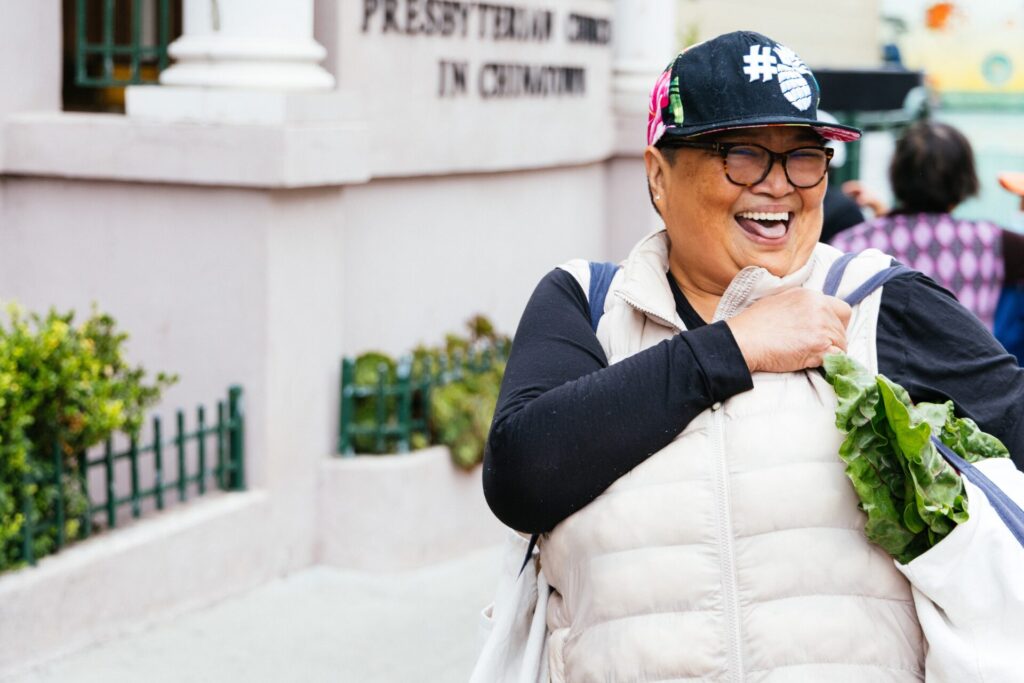
Alma retired to care for her husband, who’s on dialysis. Living on a limited income, she depends on the food pantry at Presbyterian Church in Chinatown (PCC), part of the San Francisco-Marin Food Bank’s Neighborhood Food Network, for the nutritious food her husband needs to stay healthy.  

“This pantry is a very big help,” she says. “Food is so expensive now.” 

Alma is one of what will eventually be 350 neighbors served by this pantry at PCC. Her story shows exactly why opening it mattered so much, at a moment when hunger was deepening and help was disappearing.  

Neighbors Refuse to Let Neighbors Go Hungry 

During the COVID-19 pandemic, the Food Bank launched Pop-Up Pantries across San Francisco and Marin in response to surging food insecurity. Alma went to the Stonestown Pop-Up during this time, grateful for a reliable food source while she was working but still struggling to make ends meet. 

But due to funding cuts, all Pop-Up Pantries closed last summer. Alma didn’t have anywhere to go. Volunteers lost their connection to community. Thousands of people in San Francisco and Marin lost their regular source of food. 

The Food Bank worked to expand capacity across its partner network and transfer as many participants as possible to neighborhood food pantries.  

Susie Wong, volunteer pantry supervisor, was already running two PCC food pantries: a Saturday senior pantry and a Thursday distribution at Cameron House. So, when Lesley Kraechan, an energetic, cheerful Lions Club volunteer from the North Beach Pop-Up, approached Susie about opening a third pantry, she thought they’d be stretched too thin. Then she realized the Pop-Up Pantry volunteers were eager to help.  

“These North Beach and Bessie Carmichael volunteers still wanted to work,” Susie recalled. “[Lesley and I] had like 50 people sign up, saying, ‘Please let me, I wanna help.'” 

Together, these volunteers opened the pantry less than two months after the Pop-Ups closed. Alma came to PCC to ask if she could get on the waitlist. Now, she’s grateful to pick up groceries even closer to home. 

Roots in the Community 

Susie has deep connections to Chinatown, which is why she still volunteers here despite living in the East Bay. She worked at Chinatown Community Development Center for 19 years building affordable housing. “I saw that these folks really lived with very little income,” she recalls. “A lot of them worked in the United States for decades, but they never got their Social Security because of under the table pay. They’re hardworking, but they’re struggling.” 

Like Susie, Lesley’s commitment to the pantry is rooted in her work serving the community. A physical therapist and member of PCC, Lesley started volunteering with the Food Bank during the pandemic. She works with women survivors of violence with chronic conditions and sees firsthand how poor nutrition contributes to their pain and illness. Leslie says she’s grateful that she can support the Food Bank’s mission to provide the fresh fruits, vegetables, and other nutritious food that can improve health and wellness. “If we can get healthy food to people, we can have a society of people that are healthier, happier, better,” she says. 

Nothing Goes to Waste 

With her fresh produce in hand from the pantry, Alma is already thinking about what she’ll cook next.  

“With what I get here, I can keep cooking for my family and not worry about wasting anything,” she says. 

For Alma, cooking is how she shows she cares. And with volunteers like Susie and Lesley stepping up alongside the Food Bank, this pantry ensures she’ll have the fresh, healthy food she needs to keep cooking for her family. For Alma, that’s where joy is: in the cooking, and in sharing what she makes. 

Holly Finds Food, Dignity, and Joy at the Community Market

November 24, 2025

A Bright Start 

Sunlight streams through the floor-to-ceiling windows of the Western Addition Community Market. The space is modern and welcoming, with the cheerful energy of a neighborhood bodega — energy matched by Holly. We met her as she moved excitedly through the aisles of produce and groceries, planning out what she would take home. 

“Some greens, applesauce, potatoes, carrots, eggs. Oh my god — peaches, nectarines, grapes,” she exclaims. “It is really a blessing to come here.” 

A New Way to Shop 

For six years, Holly has relied on Neighborhood Food Pantries for fresh produce each week, helping her avoid hard choices between paying bills or going hungry. When the Western Addition Community Market opened in July, it offered her a new way to shop. Now, Holly decides exactly what she takes home, how much, and when she picks it up. 

“It’s like shopping through Safeway,” she says, calling it “top-of-the-line food.” 

 Community Markets are open multiple days each week with flexible hours, making it easier for people to shop when it works for them.  

That flexibility matters to Holly, who is currently out of work and managing the ups and downs of her mental health. 

“You go in and everything is organized,” she says. “I’ve been to a lot of pantries, but this pantry here is the best. You walk through here and you pick what you want. You don’t just have to take it.” 

Simple Joys, Real Respect 

At the Western Addition Community Market, Holly savors the small, human moments of grocery shopping that many take for granted: tapping on watermelons and smelling ripe produce. 

“It makes me feel good,” she says. “You smell it and you know it’s fresh. It makes me feel good to be able to touch what I get.” 

For Holly, those simple acts restore dignity and a sense of normalcy for her in a period marked by unemployment and financial strain. The market helps ease her fears of hunger, giving her confidence that she can put meals on the table. Just as importantly, she values the respect she feels every time she comes to shop. 

“Even though I’m at my lowest right now, I feel like I have something,” Holly says. “They’re treating me with respect. Even though I’m not working, I feel respected. It’s dignity.”

The Shutdown Showed Hunger is a Policy Choice

November 13, 2025

After 43 days, the longest government shutdown in our nation’s history is finally over. Congress and the President approved a spending package that funds some departments, including USDA and federal food and nutrition programs, including the Supplemental Nutritional Assistance Program (SNAP), through Sept. 30, 2026. This means that the 42 million SNAP recipients — 125,000 in San Francisco and Marin — whose benefits were paused will now receive their benefits.  

The shutdown highlighted the fragility and uncertainty of SNAP, our nation’s most effective anti-hunger, anti-poverty program, that also strengthens local economies. Without urgent action, SNAP (known as CalFresh in California) is slated to be gutted.  In July, the approved federal budget included devastating cuts of $186 billion to SNAP, which will have severe effects on our state. According to the Urban Institute and California Budget & Policy Center, 3.1 million Californians could lose some or all their SNAP/CalFresh benefits. These projected losses equal to 1.1 billion lost meals annually in California. Last year, combined, all the state’s food banks provided almost 650 million meals 

 We must continue to fight to not only fully restore SNAP nationally, but to advocate for and develop California policies and programs to improve access and increase the adequacy of CalFresh benefits.   

Given the increased demand and uncertainties our community is facing, San Francisco-Marin Food Bank will continue our Shutdown Community Response programs until Dec. 31. These temporary resources include expanded home-delivered groceries and increased food support for partners and neighbors unable to access a food pantry. If you need food, or know someone who does, please click the Find Food button on the Food Bank’s homepage (sfmfoodbank.org).  

The government shutdown demonstrated that hunger is a policy choice. San Francisco-Marin Food Bank is steadfast in working toward policies that will combat hunger, not cause it, while expanding critical community food access programs for people experiencing hunger today. 

Partial SNAP Funding is Far From What’s Needed to Address This Hunger Crisis

November 3, 2025

In response to two court rulings, the White House and USDA agreed to partial payments of $4.65 billion in contingency resources to fund SNAP for the month of November. Partial funding is far from what is needed to address this hunger crisis. What’s needed is to fund SNAP for the month is $9 billion. But even though the federal government has the resources to do so, it chose not to help the 42 million people in our nation who rely on SNAP to feed their families.  

Much is still unknown. The timing and amounts of those partial payments are unclear and leaves 90,000 households in San Francisco and Marin uncertain about their benefits, and when and if they will receive them. Partially funding SNAP, with no plan in place for December, is an abdication of responsibility to those who rely on the program as a lifeline.  

Even in the midst of this crisis, we must not lose sight that historic cuts to SNAP have already been approved by Congress and will be enacted in the months ahead. This shutdown foreshadows the lasting harm to come. Unless Congress chooses to strengthen this vital program instead of its planned gutting, we will witness the gradual but intentional unraveling of the most effective anti-hunger program in our nation. 

Our Food Bank remains committed in our efforts to make sure people have the food they need today and will not retreat from our mission of serving those struggling to put food on their tables. Our Shutdown Community Response continues as planned. We are undeterred and will continue to work for policies that eliminate – not cause – hunger. 

Food Bank Update: Shutdown Community Response

October 31, 2025

On Saturday, November 1, people who rely on SNAP to put food on the table will not receive their benefits due to the ongoing government shutdown and decision by the USDA not to use emergency funds to support the program during the shutdown. The federal government is pulling the safety net out from under children, low-income working people, seniors, and people with disabilities. This is a devastating blow to 90,000 families in San Francisco and Marin – and millions more nationwide – who are already struggling.

We are already seeing a surge in demand for our services. Traffic to our food locator tool on our website has gone up 250% in the past week.

In the face of a crisis that was created by our federal government, we will work with our community to support impacted families and individuals.

Our Shutdown Community Response 

  • Direct cash assistance: we are proud to be in partnership with the city and county of San Francisco and the Crankstart Foundation to help provide gift cards to SNAP recipients in San Francisco to cover benefits in November. We are thrilled to see this happening, it’s an example of how public, private, and nonprofit partnerships can support our community. While we are concerned about what will happen if the shutdown lasts past November, we are relieved families in San Francisco will receive this temporary support this month. The Food Bank is actively advocating and mobilizing for a similar program in Marin.
  • Increasing community capacity: we are working with our community partners and other local organizations to support a temporary increase in their capacity to distribute food to individuals who are impacted by the shutdown. We are actively working through those plans with our partners, but this will include a temporary emergency increase in food pantry capacity along with opportunities for agencies to pick up pre-packed bags of food to deliver to their impacted community members.
  • Increased Home-Delivered Groceries: we plan to temporarily expand our Home-Delivered Grocery program to support community members who are unable to go to a food pantry right now to get the food they need.

If You Need Help 

Our temporary Shutdown Community Response programs will be available to community members who have lost benefits, government employees impacted by the shutdown, and/or neighbors impacted by increased federal immigration enforcement activity.

San Francisco households eligible for support through the pre-paid gift card program will receive a letter from the San Francisco Human Services Agency (SFHSA) that contains information on how to access their card. Letters will be sent in the first week of November. For more information about the program, visit: CalFresh Emergency Aid | sfhsa.org 

For those impacted by this shutdown or federal government immigration enforcement who need food assistance, please visit our Find Food page regularly. We are still actively working through our community response plan and many details are still coming together.  

For partners and other community organizations that are interested in joining us in this work to bring food to our community, please visit our Partner page regularly. We are still actively working through our community response plan and will have opportunities for you to engage shortly.

To Support the Food Bank 

We can’t do this alone. We are already stretched thin with limited capacity and record demand due to a hunger crisis that predated the shutdown.

You can support us by donating at www.sfmfoodbank.org/donate 

To volunteer your time, visit www.sfmfoodbank.org/volunteer. Please note, November and December are our busiest volunteer months of the year. If you don’t see a shift please check back regularly as we are continuing to update volunteer opportunities as we develop our Shutdown Community Response plans.

Food Bank Update: Government Shutdown Community Response

October 29, 2025

We are deeply disappointed to learn that Congress has not taken the necessary steps to ensure people receive their Supplemental Nutrition Assistance Program (SNAP) payments in November as the government shutdown persists.  

90,000 households of working families, single parents, seniors, veterans, and more who rely on SNAP in San Francisco and Marin to put food on their tables will not receive their benefits starting Nov. 1 due to the government shutdown.  

One in five Californians are at risk of hunger. We are already in a hunger crisis that this lapse in benefits will only serve to exacerbate.  

We also know many members of our community are experiencing increased fear about accessing food due to heightened immigration concerns. Food is a human right. No one should have to worry about their safety when accessing food. We believe in food for all, regardless of immigration status and we stand in solidarity with all in our community.  

This is why we are actively collaborating with our partners and local agencies in preparing to mobilize a temporary emergency Shutdown Community Response plan of action. We are firm in our commitment to serve those impacted during this period of a government shutdown. More details of our response are being developed. Additionally, we don’t plan to engage the National Guard in our efforts.  

We are unapologetic about providing food for all. In the face of this shutdown we are resolute in our efforts to make sure people have the food they need today and will continue to work for policies that eliminate – not cause – hunger. 

We cannot do this alone. We encourage all to stand with us, with families and our neighbors who require our help. Now, more than ever, we will need the support of our entire community. Visit www.sfmfoodbank.org to donate or volunteer.  

Individuals impacted by the SNAP delays can visit our food locator:  https://www.sfmfoodbank.org/find-food/ where we will post more information as it becomes available. 

Staff Profile: Megan on Finding Meaning in Connection

October 28, 2025

Even when you’re mission-driven, it can take a few turns to find someplace where your work truly reflects your values and you can see its impact every day. 

For Megan Coleman, that place is the San Francisco-Marin Food Bank. Her connection to the organization goes back to sixth grade. 

Megan grew up in the East Bay, where helping neighbors was part of everyday life. Through a group called the National Charity League, she volunteered with local nonprofits, including the Food Bank.  

“It was my first glimpse of how food brings people together,” she recalled. “Even at that age, I could see that food wasn’t just about surviving. It helped people connect, feel cared for, and belong.” 

After earning a law degree and spending several years working in corporate compliance, Megan realized she wanted to be closer to the kind of impact that had always motivated her. She joined the Food Bank in 2021 and quickly found her fit. 

As Senior Annual Fund Coordinator, she’s often the first person donors hear from when they call or write in. She helps process gifts, answer questions, and makes sure every supporter feels appreciated.  

“It’s meaningful to connect directly with people who care so deeply about ending hunger,” she said. 

Megan sees her role as a bridge between those who give and those who receive support. “Almost every interaction with donors is so positive,” she said. “They’re thoughtful and kind. Some give in honor of a loved one or because their grandchild volunteers with us. Those stories remind me why we do this.” 

She’s especially inspired by the way the Food Bank tackles hunger from every angle, from providing fresh groceries to advocating for long-term change. 

 “Food is more than fuel. It’s tied to health, dignity, and opportunity,” she said. “I love that our work looks at the whole picture, not just today’s needs but the future we’re trying to build.” 

For Megan, it all comes down to connection. “Every call and every conversation adds up to something bigger,” she said. “We’re not just feeding people. We’re building a community where everyone has enough.” 

Older Truck Benefits the San Francisco-Marin Food Bank

October 23, 2025

When Jeni decided to donate her late husband’s red Ford Ranger to the San Francisco-Marin Food Bank, it wasn’t just about parting with a vehicle. It was about honoring his life in the community he cared about. 

“Shel grew up in Marin and loved the outdoors,” Jeni said. “Every summer he and his dad would head to the mountains to backpack into high-country lakes to fish. One of the best parts was packing his dad’s old truck with gear and heading out into an adventure.” 

After owning several other vehicles along the way, in 2000, Shel, then living in San Francisco, bought himself a new truck — a bright red Ford Ranger XLT he named El Trucko. From then on, the two went everywhere together: work trips, road trips throughout California, including to the Sierra for hiking, fishing, and photography adventures. 

In May 2024, Shel passed away, leaving his well-traveled (and well-loved) truck behind, having logged more than 143,000 miles together. Last fall, Jeni drove Shel and the truck to the Eastern Sierra for one last trip. When she returned, she parked El Trucko in the garage, wondering what to do with it that would honor Shel’s memory. 

She searched for environmental and conservation groups whose values aligned with Shel’s, but the donation process often seemed difficult to use. To make things easier, Jeni decided the gift should benefit a San Francisco organization they both admired. 

“The San Francisco-Marin Food Bank came to mind,” she said. “We always tried to support the mail carrier’s food drive every May and donate whenever we saw barrels at local businesses or churches. It seemed impossible that in such a wealthy city, people were going hungry.” 

Through the Food Bank’s website, Jeni found that donating a vehicle was straight forward and easy. After submitting the required information, she received a confirmation and soon after, a pickup date and time. A few weeks later, she learned that Shel’s truck had sold and that the proceeds were already helping provide fresh groceries for neighbors facing hunger. 

Vehicle donations help the San Francisco-Marin Food Bank turn unused cars, trucks, and other vehicles into funding for fresh, healthy food. Each donated vehicle is sold at auction, and the proceeds support programs across San Francisco and Marin — from neighborhood pantries to Community Markets. It’s an easy way for supporters to make a lasting difference.  

“For me, seeing El Trucko go on to help our neighbors feels like the right ending to this chapter of Shel’s story,” Jeni said. “I am delighted that even a 25-year-old truck can make a difference. That feels like something Shel would be proud of.” 

Donating your vehicle will help the Food Bank provide healthy groceries for neighbors in need.  Learn more.

Food Bank Statement About Possible Lapse in SNAP Benefits

October 22, 2025

Oct. 22, 2025

The San Francisco-Marin Food Bank is extremely concerned about the potential impact to people receiving Supplemental Nutrition Assistance Program (SNAP) and USDA’s Special Supplemental Nutrition Program for Women, Infants, and Children (WIC) benefits should the government remain shut down and fail to take proper steps tomorrow to ensure benefits are issued.  There are 90,000 working families, single parents, seniors, veterans, and more who rely on SNAP and WIC in San Francisco and Marin to feed their families – we are calling on Congress to ensure the payments continue during this Shutdown and reverse the devastating SNAP cuts they approved in July.

Food is a basic human right, and yet our community is already facing unprecedented levels of hunger. This is untenable. Having a pause in SNAP and WIC benefits during this shutdown foreshadows what will happen when devastating national efforts to slash critical social safety nets go into effect.  

We appreciate Governor Newsom’s recognition that food banks are crisis response organizations.  As with other emergencies, the Food Bank will continue to be on the front lines of ensuring our community can put food on the table should our federal elected officials choose not to take steps by tomorrow to ensure people can access the benefits they need.  

We learned about the decision to deploy the National Guard to support food banks this morning at the same time it was announced to the press. At this time, we don’t have more information to share about if and how they will support our Food Bank, as we are waiting to learn more.