

 “Hunger doesn’t just go away because you stop counting it.”
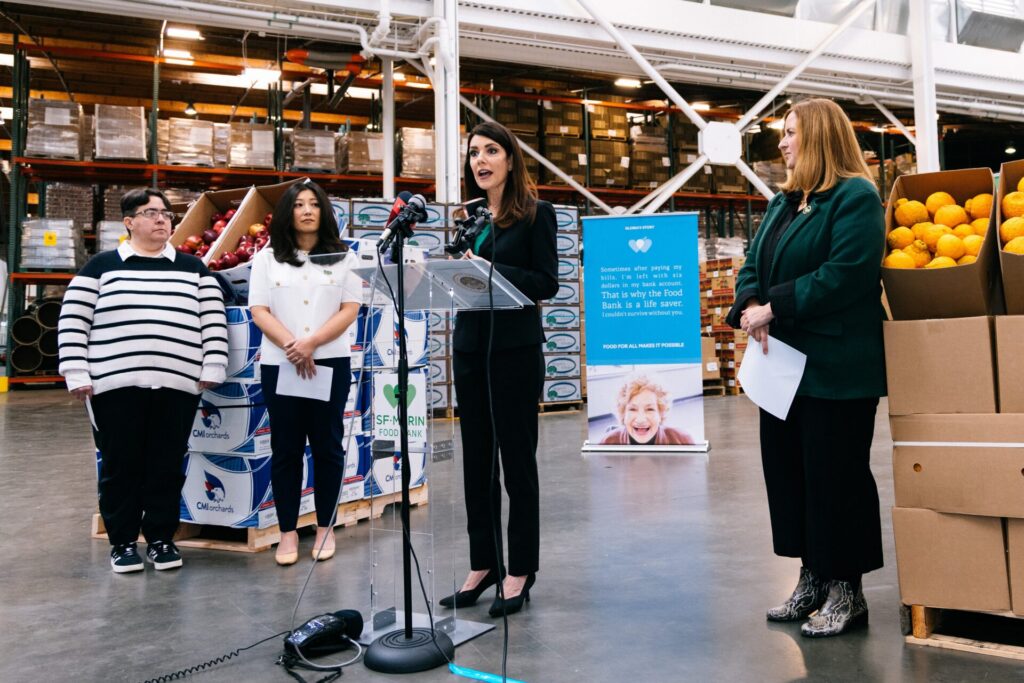
That was the message from the San Francisco-Marin Food Bank’s Executive Director Tanis Crosby at a Jan. 30 press conference announcing new state legislation to protect food insecurity data in California.
“Let’s be clear. Our neighbors are counting on us, so we’ve got to count what matters,” she continued. “We cannot serve our community without data and insight into hunger.”
State Assemblymember Catherine Stefani (D-19) introduced The Count Hunger Act, which would restore funding for a screening tool that identifies food insecurity across California. In early January, the food insecurity screener, a critical part of the California Health Interview Survey (CHIS), was canceled when the administration eliminated SNAP-Ed funding.
“The federal government chose to stop counting hunger and hope no one would notice,” said Assemblymember Stefani. “But hunger doesn’t disappear when you stop measuring it — it just gets easier to ignore. This proposal is about California stepping up where Washington walked away, restoring the data communities need to understand who is struggling, target help, and confront food insecurity with honesty and urgency.”
This latest cut is part of a pattern. In October 2025, the USDA canceled the nation’s annual Hunger Survey. Now, expected cuts to the Supplemental Nutrition Assistance Program (SNAP) could cause as many as 22,000 San Francisco and Marin residents to lose access to this critical food assistance program.
Noriko Lim Tepper, the Food Bank’s Chief Strategic Partnership, Advocacy and Voice Officer, emphasized that the proposed legislation goes beyond restoring data collection. It would also pilot expanded guidelines to assess hunger in high-cost areas.
“We cannot afford to leave valuable information on where hunger exists in the dark,” said Noriko. “Reliable methods for identifying food insecurity can help improve outcomes for our working families. Families earning nearly twice the 200% FPL — the federal poverty level — benchmark, which is about $64,000 for a family of four, are still struggling. If the FPL in the CHIS screener doubles, this ensures every Californian experiencing food insecurity is seen.”
Greer Dove, a former Food CARE (Community Advocacy Resilience Equity) Council member, knows these challenges personally.
“Living in the Bay Area is so expensive,” she said. “I am so happy that Assemblymember Stefani is proposing this bill, both to be able to continue finding the people that need this help and also to be able to expand the benefits that people need.”
If approved, the two-year pilot would restore CHIS food insecurity funding and expand eligibility to reflect reality: many working families earning above traditional poverty thresholds still can’t afford food amid rising housing and living costs. This expanded definition could eventually inform eligibility criteria for programs like CalFresh.
For the Food Bank, backing this legislation is a natural fit. Data-informed decision-making drives everything we do, from the policies we support to how we get food to our neighbors. We can’t solve a problem we can’t see. And as Tanis said: we’ve got to count what matters.
The January 30 press conference received ample media coverage, with several news outlets covering the event, including KQED, KCBS, KTVU-TV and KRON4-TV.
Share