
Ending hunger takes more than food. It takes trusted partners who know their communities and show up for them week after week. For Black History Month, we’re spotlighting three partners whose service to their neighbors is also a reflection of the Food Bank’s mission and commitment to the leadership of our partners in providing community-led solutions to hunger.
Shanell Williams, Rafiki Coalition for Health and Wellness
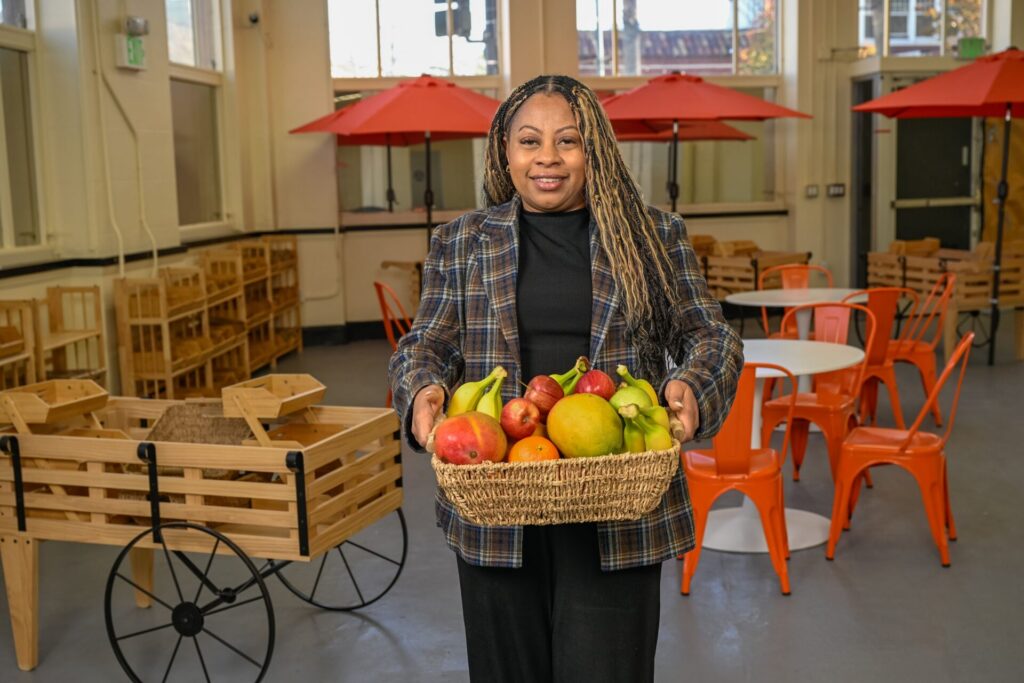
In partnership with the Food Bank, Rafiki Coalition for Health and Wellness recently opened a Community Market at Umoja Health Access Point in Bayview Hunters Point. Resembling neighborhood grocery stores, Community Markets let participants choose the proteins, produce, and culturally relevant foods they bring home, and are open multiple days each week. The program centers on respect for participants and the power of choice. It also connects them to behavioral health, wellness, and other supportive services that address the root causes of hunger, all under one roof.
For Shanell Williams, Rafiki’s executive director, food is an entry point for overall well-being. “To really be healthy, it’s not just one domain,” she says. “It’s making sure that folks have access to mental wellness, complementary medicine, supports for chronic health conditions. And food is a big part of that.”
Bayview Hunters Point has long been a food desert, and Shanell sees Community Markets as a direct response to that history. “What we love about the community food market is that it’s open access, low barrier, and it’s also about dignity,” she says. “Just because folks are needing to access services doesn’t mean we lose that piece around dignity.”
Shanell grew up in the Fillmore, San Francisco’s historic Black neighborhood known as the Harlem of the West. Her community-focused leadership journey includes community organizing serving eight years on the San Francisco Community College Board and a decade at UCSF as the Director of Community Engagement and Partnerships at the school’s California Preterm Birth Initiative program. At Rafiki, she hires from the community and builds career pipelines for the people who do the work alongside her. She calls them “PhD doers,” honoring their lived expertise. “It’s really for me about community empowerment,” she says.
Chester Williams, Community Living Campaign

Shanell’s work connects people to food and services in one place. Chester Williams brings both directly to people’s doors.
Every week, the Community Living Campaign (CLC) helps get bags of fresh groceries to roughly 140 elderly neighbors who can’t get to a pantry on their own. The Food Bank supplies the fresh produce and groceries. Meals on Wheels San Francisco provides the operational space. And Chester’s team of volunteers packs the bags and delivers them door to door. As Bayview food coordinator for CLC, Chester has spent more than a decade coordinating home-delivered groceries for seniors across Bayview, Visitacion Valley, Parkmerced and Lakeview.
Chester grew up in the Fillmore. He’s Catholic, raised in a tradition of service and commitment to the common good at St. Dominic’s and Sacred Heart. That foundation carried him from teaching elementary school to directing a community technology lab to His delivery routes today reach seniors who speak Cantonese, Mandarin, Spanish and other languages. For Chester, making sure every participant feels understood and cared for is the whole point. “I grew up with that feeling of you need to help others no matter who,” he says. “After a while, it’s not even a job anymore. You just automatically put that in.”
Veronica Shepard, San Francisco African American Faith-Based Coalition

Chester serves individuals one door at a time. Veronica Shepard mobilizes entire congregations.
When Veronica and a colleague conducted food security screenings at Black churches across San Francisco, the results were stark: congregants were going hungry, and their pastors had no idea. “These pastors learned their own congregants were hungry and they were blown away by the results,” Veronica says. “Food is relative to everything. You can be unhoused, but you still got to have food.”
That discovery united faith leaders across the city. In 2016, Veronica formed the San Francisco African American Faith-Based Coalition, bringing pastors, ministers and leaders from across denominations together around the urgency of food insecurity. The coalition impacts some of the city’s most vulnerable populations (Black/African American, Pacific Islanders, Latinx, Black and Middle Eastern Muslims) which have been partnered with the Food Bank for the past six years.
Each December, the coalition produces Feeding 5,000, a holiday food distribution that has brought food to more than 22,700 households since the pandemic. But the work continues year-round. “Hunger is not just a holiday event,” Veronica says. “Hunger is every day.”
Veronica is a native San Franciscan and grew up in the Bayview Hunters Point Neighborhood during the civil rights movement, and she carries that history with her.
“I know there’s strength in numbers,” she says. “Just like then, we’re working to make justice happen today.” She reflects on Dr. Martin Luther King Jr.’s speech to the Medical Committee for Human Rights, in which he stated, “injustice in health is the most shocking and the most inhuman.”
Veronica emphasizes that hunger is merely a symptom of a much deeper ailment.
“If we don’t address the root cause of hunger, which is poverty,” she explains, “we are failing to confront the structural injustice that keeps our community in a cycle of need. Without addressing the underlying poverty, the cycle of inequity remains unbroken.”
Looking Ahead
The Food Bank works with 265 community partners across San Francisco and Marin to end hunger. The works of Shanell, Chester and Veronica reflect what that partnership looks like when antihunger efforts are led by those who know their community best. We are grateful to walk and work alongside them.
Share