
Food Bank Participants experiencing Food Insecurity


Food is a basic human right. Yet, today in California, more than 1 in 5 people struggle with food insecurity. Seniors are choosing between food and medicine, parents are cutting back to feed their kids, and working people are worrying if they’ll be able to put food on the table after paying the rent. Devastating national efforts to slash critical social safety nets, cuts to local food programs, and immigration policies that make people fearful of accessing basic services will only deepen these challenges.
Hunger is a policy choice, and our Food Bank is bracing for the impact of national policy choices that will push people already struggling to the brink. We are sounding the alarm on the crisis to come.
people are food insecure in California
calls to 211 to find food assistance in San Francisco and Marin compared to the previous year
people are currently on the Food Bank’s waiting list
households in San Francisco and 1 in 4 in Marin do not earn enough to meet their basic needs1
1 According to the United Way Real Cost Measure. San Francisco: https://unitedwaysca.org/wp-content/uploads/2025/04/2025-RCM__San-Francisco-County.pdf. Marin: https://unitedwaysca.org/wp-content/uploads/2025/04/2025-RCM__Marin-County.pdf
Earlier this year, the Congress passed a disastrous budget bill that will slash the Supplemental Nutrition Assistance Program (SNAP/CalFresh in California) by $186 billion. Federal SNAP cuts are estimated to result in the loss of 6 billion meals annually – to put that in perspective, the entire Feeding America network distributed enough food for 6 billion meals last year. Food banks simply can’t make up the difference.
As many as
people could lose benefits, according to some estimates.2
meals could be lost annually.3
2 Estimate from California Association of Food Banks report: CalFresh Recipients At Risk Due to H.R. 1 Changes (https://www.cafoodbanks.org/calfresh-recipients-at-risk/)
3 Based on average benefit amount for adults at risk of losing benefits divided by a standard per-meal cost of $2.681, based on the 2024 Thrifty Food Plan for a reference family of four.
“My concerns about the cuts are that I need access to healthy food because it helps me continue to survive and thrive living with HIV and AIDS. The hope is that I can continue to get at least a little amount that I get from CalFresh because it does help. This has got me very stressed.”
SNAP or CalFresh in California is the most effective anti-hunger program we have. It disrupts poverty by putting grocery money directly in people’s pockets.
Yet, despite its effectiveness, in California it remains underutilized. California has consistently lagged behind other states in SNAP enrollment with a lower participation rate than at least half of the other states. It is estimated that there are 2.7M people eligible for CalFresh, but not enrolled – resulting in $3.5B in benefits not used to buy food. When we asked our participants why, we heard that many people didn’t know they were eligible.
Only
of eligible people in California are enrolled in CalFresh4.
of participants not enrolled in CalFresh don’t think they are eligible.
This is why the Food Bank co-sponsored AB518, a bill requiring the state to identify those eligible for CalFresh and take culturally appropriate steps to enroll them. Meaningful policy change can reduce hunger.
California also has one of the highest program administration costs in the country. Urgent reform is needed to make sure the program doesn’t become even less accessible and more expensive to operate.
4 According to the USDA, Reaching Those in Need: Estimates of State Supplemental Nutrition Assistance Program Participation Rates in 2022 (https://fns-prod.azureedge.us/sites/default/files/resource-files/ear-snap-Reaching-Those-in-Need-2022.pdf)
The cost of living in Marin and San Francisco is so high that an individual would need to work approximately 1.5 full-time minimum wage jobs in San Francisco and 1.75 in Marin just to cover their basic expenses5. This financial reality is why even with 67% of respondents working, 68% are also experiencing food insecurity.
5 Based on United Way’s Real Cost Measure (https://unitedwaysca.org/realcost/) and a $16.50 minimum wage in Marin County and a $19.67 minimum wage in San Francisco County. Full time is defined as 40 hours per week, 50 weeks per year
Ever-rising prices and an unattainable cost of living are forcing families to choose between housing and food, transportation and food, healthcare and food. With so many fixed expenses, food is often where families cut back to try to stretch their budget.
report cutting back on meal size or skipping meals because there wasn’t money for food.
report eating less than they should because there wasn’t enough money for food.
For parents the tradeoffs can be even more challenging. When many families are paying nearly as much for childcare as they are for housing6 it’s no wonder the rate of food insecurity among parents using our services is 21% higher than among households without children. Parents are cutting back to make sure their children have enough.
6 Based on United Way’s Real Cost Measure (https://unitedwaysca.org/realcost/)
of parents report cutting back on meal size or skipping meals because there wasn’t enough money for food.
of parents report eating less than they should because there wasn’t enough money for food.
“I do know a lot of parents who oftentimes will have to defer and give the food to their kids, and they’re not eating enough themselves. That’s something that is often overlooked, and I think something needs to be done about that.”
The Food Bank serves 36,000 households weekly in San Francisco and Marin or 1 in 12 households in both counties – a number the is projected to go up this year. For those families, our services are working. Our participants are 15% less likely to experience food insecurity than those on our waitlist. The Food Bank is relieving the pressure of the tough choices our community is making between food, housing, healthcare, childcare and other basic needs.
But it’s not enough. Our services are supplemental, 68% of people enrolled in our program are still at risk of hunger. When 1 in 5 Californians are food insecure, food banks can’t reach everyone. To truly end hunger we must not only ensure people have access to the food they need today, but also transform policies and eradicate hunger’s root causes.
No matter your political persuasion, we should all want to end hunger. To do that we need innovative solutions and bold action from our policy makers and supporters. If you want to join us in the fight to end hunger: donate, volunteer and make your voice heard.
Learn more: https://www.sfmfoodbank.org/advocacy/
Asian
59.6 %
Latine
22.1 %
White
10.5 %
Black/African American
5.7 %
Mixed Race
0.7 %
Middle Eastern/North African
0.5 %
Native Hawaiian/Pacific Islander
0.4 %
Native American
0.4 %

70% female

72% senior

26% have children

52% disability in
household

4% veteran in
household

2% unhoused
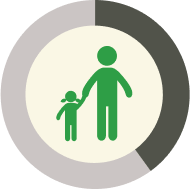
40% Single Parents
(of those with children)

73% first language
other than English