Ten days ago, we thought that healing from the Coronavirus pandemic was the paramount issue and job at hand – maybe of our time. Today we know that we have even greater and far-reaching healing to do around issues of justice and race that will not wait for a vaccine or a cure and must have our attention now. These times call for all of us to be focused on the work of challenging injustice and championing humanity.
We believe that having enough food to eat is a basic and foundational building block in the pyramid of justice, and we strive to bring nutritious food to everyone.
Income inequality
And there is another curve that must be flattened and then reversed – the 50-year march upward of the curve that measures income inequality. People of color are over-represented on the low end of the curve and experience the brunt of inequality daily. All of our institutions must be examined to root out ingrained policies and practices that keep people of color from succeeding. And the sharp edges of capitalism must be softened with policies that ensure fairness, access, and opportunity.
#FoodForAll
Please know that the Food Bank remains committed to getting food to those who need it. As long as it is safe for our staff, volunteers, and participants, our pantries will remain open to all.
Thank you for joining with us to fight to end hunger, and with it the fight for greater equity and justice in our communities.
With Gratitude,
Paul Ash
Executive Director
All of our institutions must be examined to root out ingrained policies and practices that keep people of color from succeeding. And the sharp edges of capitalism must be softened with policies that ensure fairness, access, and opportunity.
On a warm, borderline hot, Wednesday morning, Sara Cruz stands on the blacktop of Rosa Parks Elementary School directing volunteers. Everyone is hard at work. It’s nearly 9 a.m., and it’s almost time for the Pop-up Food Pantry to open.
However, Sara wants to check in on the line before the Pop-up Pantry opens. While the school is tucked away in a shady enclave, it sits at the nexus of Western Addition, the Filmore District and
Japantown – meaning even with shelter-in-place traffic levels, the majority of the line snakes along some busy streets.
As she moves at a fast clip, she reminds participants to maintain a six-foot distance from one another and to keep the sidewalk clear for passersby. Sara is also using this opportunity to touch base with volunteers and disaster service workers stationed to manage the line. She makes sure they have enough water and an understanding of their role for the day.
Sara and her husband Edison are co-leads of the Pop-up Pantry at Rose Parks Elementary School. Every Wednesday, they welcome the Food Bank delivery truck, instruct the volunteers, pack food bags, greet participants, and hand out food. Sara is part of the Food Bank’s Young Professionals Council (YPC), where she first heard about the opportunity to co-lead a pantry. Since Rosa Parks is walking distance from Sara and Edison’s apartment, it was a convenient way to engage with their community during this time.
10 Weeks in and the Growing Need
Rosa Parks was one of the first emergency Pop-up Pantries the Food Bank opened after shelter-in-place went into effect. With the help of countless community volunteers, it now serves around 1,200 households every week.
At the end of what turned out to be a half-mile long line, Sara told one patient participant who lined up early, “we start around nine, things will start moving soon.”
Rosa Parks is just one of 25 pop-ups and 217 neighborhood pantries that remained open after shelter-in-place. Overall, the Food Bank is serving nearly twice as many households as it was before the pandemic.
Stepping Up with Their Community
This is only possible because community members like Sara and Edison saw a need and stepped in. “I am so surprised by how proactive and supportive the community has been,” said Sara. “The volunteers we’ve seen on-site are extremely willing and able; they just want to help out and support as best as they can.”
For the couple, doing this work feels personal – both Sara and Edison were laid off at the end of last year. “Neither of us is working right now, so we understand that the pandemic is affecting a lot of people in adverse ways,” explained Edison. “This was an easy opportunity to give back to the community.”
Sara echoed that sentiment. “When we look back and ask ourselves: ‘What was I doing to help during this time?’ I can say we were doing this,” she said. “We’ve met some really interesting people through this experience – many of them have become our friends.”
“When we look back and ask ourselves: ‘What was I doing to help during this time?’ I can say we were doing this.”
Food insecurity hits seniors particularly hard, especially when they are trying to balance a fixed income with the rising cost of living. Even before the pandemic, one in seven adults between the ages of 50 and 80 nationwide were already food insecure. Those who had recently experienced food insecurity were twice as likely to say their diet was fair or poor.
For many low-income seniors, COVID-19 only exacerbates these challenges by layering on the health risks now associated with meeting their basic needs like going out to get food.
Our temporary Pantry at Home program supports the health of seniors by ensuring they are getting a bag of fresh groceries – including fruit, vegetables, grains, and high-quality protein – delivered to them every week. Because of the generous support of our volunteers and partners, close to 12,000 seniors do not need to risk their health to pick up groceries each week.
We spoke with volunteer Esther Honda about her family’s experience delivering groceries to some of our community’s most vulnerable.
Food Bank: When did you start volunteering with us and why?
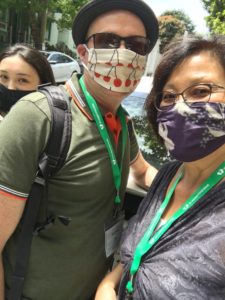
Esther Honda: We started volunteering once shelter-in-place started. I knew I wanted our family to volunteer at the Food Bank, and it just worked out well for us to deliver groceries. I have to confess that it seemed like a good excuse to get out of the house but also felt really necessary to help others who could not safely leave home.
FB: Can you describe the experience?
EH: We drive over to the Food Bank warehouse on Pennsylvania Street, back in, and are greeted by friendly volunteers who check us in and offer to help us load up our bags of groceries. There are 3 of us in the family so we manage fine, though. Then we turn on the delivery app and head out to a well-organized list of clients.
FB: You are volunteering with your family?
EH: We volunteer as a family, and we all agree that it’s a great thing to do together! As soon as I signed us up, the family was totally on board.
FB: Are you at all concerned about your health and safety while volunteering?
EH: We wear gloves that the Food Bank hands out, plus our own masks, and we try our best to make as little physical contact as we can.
There has not been one time when we felt unsafe, though, in any neighborhood. I will say that people in all the neighborhoods we have delivered to have been really kind and helpful. It seems like folks can tell you are out there to help others and often offer to hold a door open for you, show you where an elevator or particular house or apartment number is, and to help you get food to the recipients.
FB: Have you learned anything new or surprising during your volunteer experience?
EH: My husband and I have lived in San Francisco for over 30 years, and until we started delivering, there were some neighborhoods in our city we had never been to. It’s expanded our own sense of our city.
FB: How has the volunteer experience impacted you?
EH: Volunteering has made us feel more useful and less like we’re spinning our wheels during this time. We feel like we’re doing something positive and worthwhile. We’ve done lots of things as a family that were community-oriented, but usually, these things have been about the public schools our kids have gone to. This is the first time we’ve gone out to volunteer our support to others as a family. Our teenage daughter has done this on her own, though, so this is actually a bigger step for us, the parents.
FB: What would you say to other people who may be considering volunteering but are on the fence?
EH: Do it! Especially if you are bilingual or have even a tiny bit of language ability in Russian, Spanish, Cantonese, or Mandarin! You are needed, and you will feel appreciated. I have personally been so grateful for the opportunity to get out and volunteer, and the Food Bank makes it easy to sign up for shifts that fit our schedules.
We strongly recommend volunteering with a family member or roommate. It makes dropping off easier and more fun.
FB: What is your favorite part of volunteering?
EH: Our daughter says her favorite part is the cute old people and how appreciative they are when we drop off. They smile and often thank you repeatedly, even when they speak little or no English. It’s very rewarding.
FB: Is there anything else you want to share about your experience?
EH: Some people might feel hesitant driving and dropping off in neighborhoods they are not familiar with or in housing projects that they might have thought to avoid for safety reasons in the past. I have had to confront my own privilege and biases while delivering somewhere unfamiliar for me and have learned the simple truth that it’s ok… These are people, just living their lives! And they’re very appreciative. If nothing else, I hope that the public health reality has shown that we are all, as San Franciscans and as humans, facing this challenge together. We need to support one another, and food is a very basic need that brings joy and togetherness, even when we have to be apart.
If nothing else, I hope that the public health reality has shown that we are all, as San Franciscans and as humans, facing this challenge together. We need to support one another, and food is a very basic need that brings joy and togetherness, even when we have to be apart.
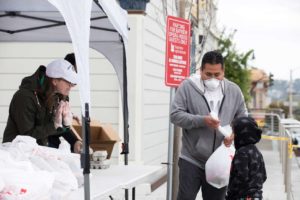
With two young sons to support, the pandemic has created a lot of stress for Doaldo. On top of navigating remote learning with one son and wondering if his other son – four-years-old – will be able to start school this fall; he worries about how he will continue to put food on the table.
“I haven’t worked in a month,” said Doaldo, who worked in restaurants before the pandemic. “We don’t have money for food or anything.”
Like thousands of service industry workers, Doaldo is struggling with the impact of regional shelter-in-place orders that have brought a once-thriving industry to a screeching halt in an effort to protect public health.
For Doaldo, who learned about the Bayview Opera House Pop-up Pantry from a friend, relying on the Food Bank is new. But with little time for their family to prepare for the sudden job loss, and no other help, it has been a big relief.
“I got potatoes, eggs, and cabbage,” said Doaldo. “Those are the most important things we use to cook, and the kids love the bananas and other fruit.”
Nodding to his four-year-old son, who held his dad’s hand through the whole line, Doaldo smiles and adds, “last time they had juice and he liked that.”
Weathering the Challenge
A family with two full-time minimum wage jobs earns $58,240 a year – in notoriously expensive San Francisco, it takes $110,984 (according to the California Budget & Policy Center) to cover their basic needs. A sudden job loss can be catastrophic for a family already struggling to get by.
The Food Bank is a stop-gap to ensure parents like Doaldo, who are unexpectedly facing hard times, can continue putting food on the table for their children.
“We are living in very hard days; we’ve haven’t worked in a very long time,” explained Doaldo. “We don’t have any money and we have to pay for everything – bills, rent, food – it’s very difficult.”
"We are living in very hard days; we’ve haven’t worked in a very long time. We don’t have any money and we have to pay for everything – bills, rent, food – it’s very difficult." -Doaldo
When schools closed in March, parents and caregivers were immediately left figuring out how to balance work, childcare, and homeschooling their children. For the families who relied on the Food Bank every week, there was an added layer of stress – where would they get their groceries? Prior to shelter-in-place, manyfamilies could pick up the fresh groceries at their school pantry during drop-off or pick-up. Across San Francisco and Marin, school closures caused 46of the Food Bank’s Healthy Children food pantriesto stop their weekly distributions
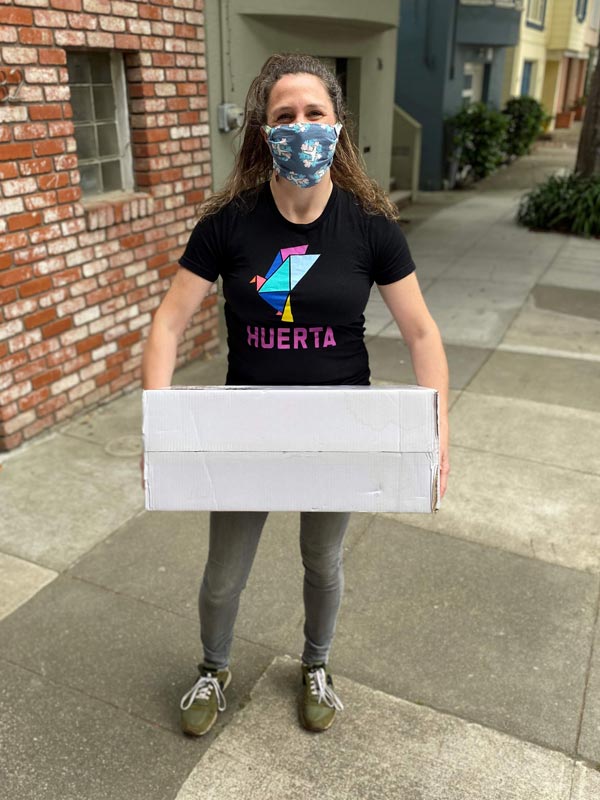
One such pantry was at Dolores Huerta Elementary Schoolin San Francisco’s Mission District. When the school closedteachersand staff quickly worked to identify and contact families to let them know where they could access food. Even with new available pop-up pantries opening nearby, with vulnerable relatives at home, some families could not attendnearby Pop-up pantries. The school’s Family Liaison, Nataly Terrazas; Elementary Advisor, Luis García; School Social Worker, Sarah Volk, and school parent and pantry coordinator, Casey Federico quickly sprang into action matching families who couldn’t leave their house with volunteers who could pick up and deliver food to them. They now have 30 volunteers who trade off delivering to 13 families.
Last week we caught up with Casey to learn more about what is happening in their community.
(This conversation was edited for length and clarity.)
Food Bank: How did you start partnering with us and what have you been doing since the start of the pandemic?
Casey Federico: At Dolores Huerta, which is both of my daughters’ elementary school, there was an established food pantry every Monday morning. Another parent had coordinated it before me, but their son graduated, so I took on the job of being the pantry coordinator this fall. Even before shelter-in-place, we were seeing a huge expansion in need for the pantry. We grew from a 50–person pantry last year to a 70- or 80-person pantry in November.
When the shelter-in-place happened, I was in communication with Edith, our neighborhood representative from the Food Bank, and knew everything was shifting. At the same time, I was getting all these texts and messages from families at the school saying, ‘we are about to be out of food’ There were lots of different challenging situations. And so, from discussions with the school team – Sarah, Luis, and Nataly – we found out who couldn’t leave their home for whatever reason and identified 12 families who needed food delivered. We started with a group of volunteers –families who did have transportation and could go to a food pantry and pick up a box and then deliver it to those people’s homes.
Our School Social Worker, Sarah Volk, is such an inspiration. She was just so careful and thoughtful about confidentiality. Sarah asked families who they’d be okay being paired with, because to have someone know you are receiving food from the Food Bank and then know where you live, that is a big deal. She was just super thoughtful about that and got everybody’s permission all along the line.
FB: What are you hearing from people in the community now?
CF: I’m still hearing a lot of people saying, you know, we got this [food], but it isn’t really enough. That is the hard reality. So many families that are part of our community are hospitality workers, etc.
Another amazing thing that happened is one of our teachers, her fiancé owns a restaurant and every time somebody from the community buys a meal in his restaurant, Toma, he’s donating a meal to a family in need. He’s also delivering meals. So, families are getting additional support from that too.
But what I just heard from Sarah last week, is just the numbers are increasing so much. So, we are talking about how to meet new needs. It’s really challenging.
FB: Do you talk to the families you deliver to? How are they doing?
CF: One thing that’s been really good, is a lot of relationships have been built between the families who are delivering and the families who are receiving. I know everybody’s been sending texts like, I’m going to drop it off. They text, I got it, thank you.
There’s also been some specific communication around needing health items like toothpaste and soap and tampons, and that kind of stuff. A few volunteers who have the capacity have also been sharing those types of items with families. Many of the families who are delivering are also out of work or running low on food themselves.
FB: We see this too, it’s incredible how many of our volunteers say, ‘oh yeah, I’m out of work right now and so I have free time and I’m going to do this.’
CF: I know, it just takes my breath away. One of the women who is helping deliver said ‘oh yeah, we both lost our jobs last week, but this is just so important, it’s the one trip I have purpose around. I have to do this.’
FB: Is there anything else that you wanted to share about the experience?
CF: I think the one thing that the Food Bank really does is bring together a community of people. Almost everybody who volunteered at the weekly food pantry at Dolores Huerta is also receiving a box of food. And so, I think our, our community of folks who really view themselves as part of the system were ready to jump in. The group of parents who help us to set up, fold up boxes, and do all that kind of stuff are really jumping up again to help out, which is cool.
That sort of friendly, joyful mood that was at our Monday morning pantry translates over and made people feel comfortable to be both asking and giving. I’m so proud to be part of this community!
To meet the exploding need for food during the pandemic, the Food Bank opened 20 Pop-up pantries across San Francisco and Marin, each serving roughly ten times more people each week than our regular pantries. In the south-east corner of San Francisco, the Bayview Opera House was one of the first Pop-ups we opened after shelter in place went into effect.
Set up in the parking lot between the Opera House and Joseph Lee Recreation Center, the pantry is staffed by volunteers outfitted with masks and gloves always maintaining a safe distance. They say there are many “this is why we are out here” moments – whether it’s participants’ relief that they’ll be able to put food on the table for the week or folks new to the Food Bank who are surprised to open their bag and find that about 70% of what the volunteers bagged for them is fresh produce.
Finding A Way During the Shutdown
The Bayview Opera House is now serving more than 1,000 households every Monday. The line often stretches down Newcomb Ave, around on 3rd Street, and back up the hill on Oakdale, but it moves quickly – social distancing can be deceiving.
Once at the front of the line, participants are greeted by a friendly volunteer with a clipboard who asks them how many people are in their household, before they are handed a bag of groceries.
For Maria, who lost her job in the crisis as a childcare worker, standing in line is worth it, “I know there are a lot of families who are thinking: rent or food?” She has been trying to figure out what to cut from her budget so she can support her family as the shelter in place continues. “This really helps because I have two teenagers at home who eat a lot. Before I was spending $150 per week for just one meal a day. Now, they are eating three meals.”
James, a tour bus driver, said: “I came to work, and it was just shut down.” Without the tours he has had trouble making money, “my savings are gone so the Food Bank helps.” He loves that he can still get a variety of proteins. “Last week I got eggs. I killed those eggs! Once, there was pork loin. I killed that too!”
For Jasmine’s family, the pop-up pantry is a lifeline. Jasmine lost her hotel job and lives with her mom, who has a health condition that makes her vulnerable to COVID-19, and with her brother, whose hours were cut as his airline job. “Honestly, I don’t even know how we are getting by. By the grace of God, we are living day by day,” she said. “It’s a little stressful figuring out the craziness of how you are going to pay rent and buy food.” But the pop-up pantry helps, “because two out of three of us are not working, it helps
us save money and not waste the last of our savings.”
The Pop-ups are a welcome sight, with passing cars often giving us a friendly honk. The Food Bank and our volunteers make sure the community knows we’re here for them in this crisis, and we are all in this together.
Elisabeth Fall is a freelance photographer who regularly shoots for the Food Bank. Since the pandemic, she’s lost most of her business. But that hasn’t deterred her from helping others.
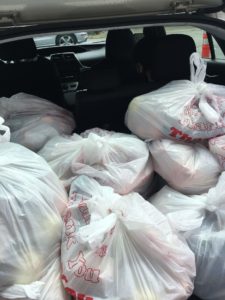
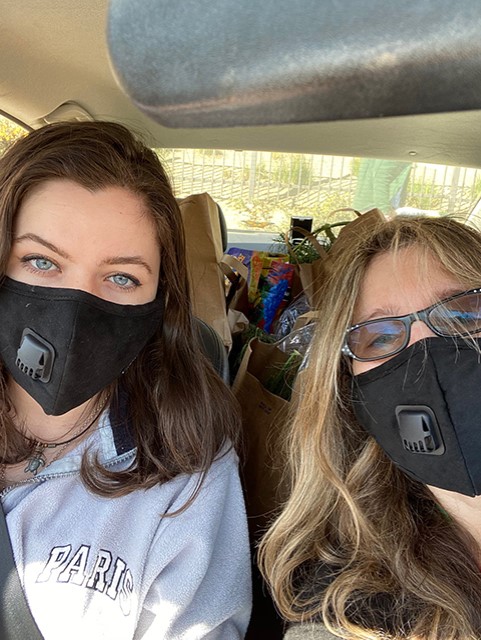
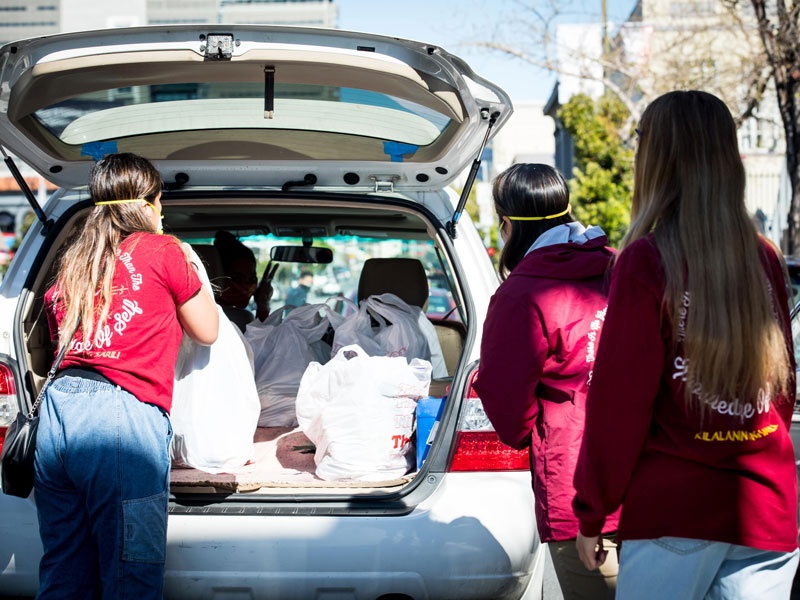
Twice a week, she loads up her car with 15 bags of groceries and delivers them to seniors as part of our brand-new Pantry at Home program. It’s a temporary service making sure that the Food Bank’s participants who are over 65 years old get food during this crisis.
“It’s sobering to think how long this crisis will go on,” said Elisabeth. “But I’m spending my new free time doing something I’ve wanted to do for years: volunteer for the Food Bank.”
“One thing that I love about delivering groceries is that I feel like I have a purpose, and it deflects energy away from my own underemployment to think about the people around me. It’s such a gift.”
A fleet of volunteers and partners
With the help of volunteers and partners – including, OnFleet, Amazon, Cruise, Uber Eats, and DoorDash – we’ve been able to completely shift our distribution model almost overnight. Now our most vulnerable participants can still receive groceries while they are protecting their health by sheltering in place.
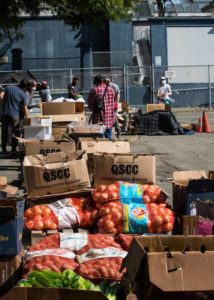
Each and every day a tireless group of volunteers and county disaster service workers pack 1,200-1,500 bags of groceries under a giant tent in our warehouse parking lot. The tent has become an extension of our warehouse – giving volunteers the space they need to social distance, while still packing up fruits and vegetables, protein, grain and other nonperishables.
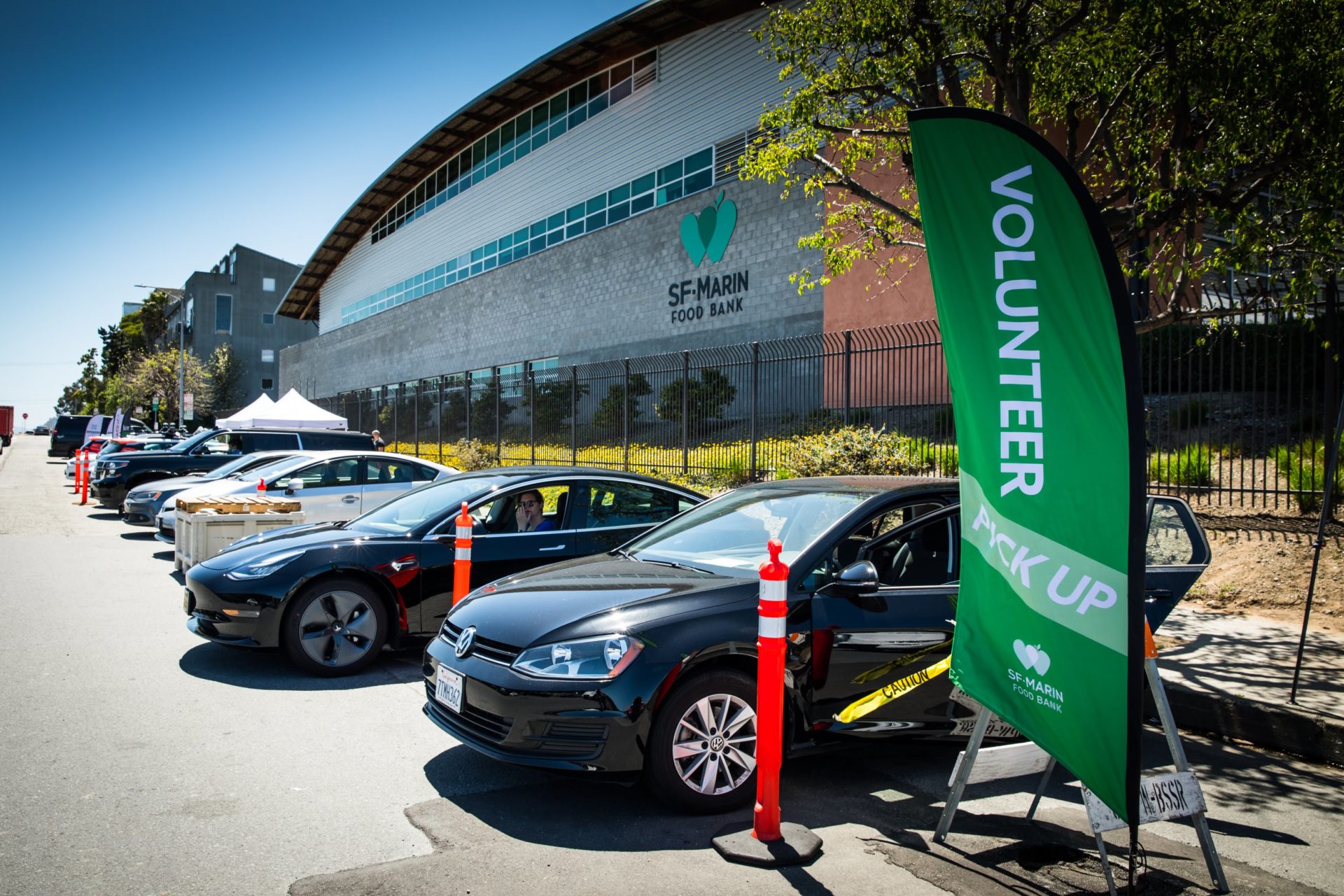
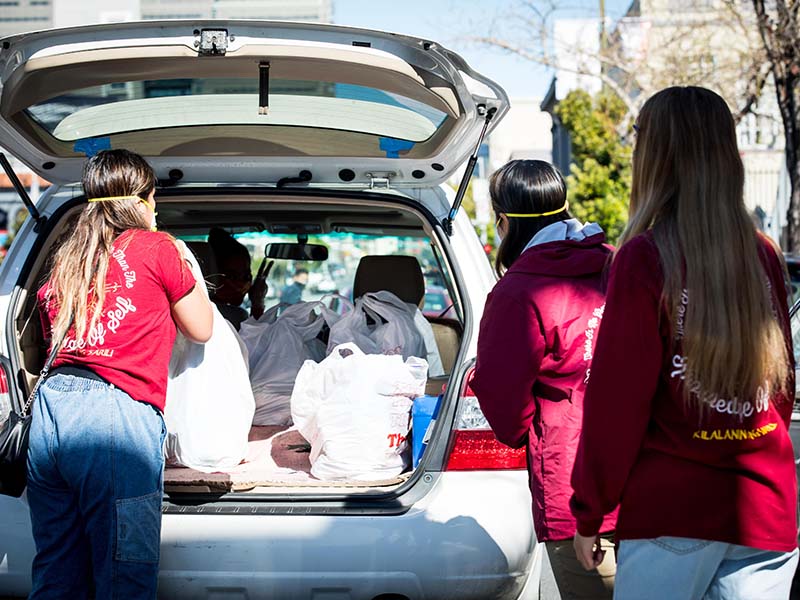
As the bags are being packed, drives from our fleet of volunteers and partners arrive continuously throughout the day. They back up to our curb on Pennsylvania Ave., check in with a curbside volunteer or staffer and start loading up their cars with 15-20 bags or boxes packed and ready for delivery throughout San Francisco.
A thank you smile
When Elisabeth makes her rounds throughout the city, she is often joined by her daughter. Together, they knock on doors, put the groceries down, and stand back six feet.
“We are always met with smiles when folks open their doors, and they are always so appreciative – which is a bonus. It’s nice to have contact with people, even for a minute from six feet away with masks on,” said Elisabeth.
“When the chips are down – and these are tough times for so many – volunteering is eight hours of my week helping people connect to food, and food is love. So, it’s a good feeling.”
We all hope that the crisis will pass soon, and that active seniors can go back to visiting their regular neighborhood pantries. But until then, the Food Bank’s temporary Pantry at Home program will be here for our seniors.
One thing that I love about delivering groceries is that I feel like I have a purpose, and it deflects energy away from my own underemployment to think about the people around me. It’s such a gift.”
In the weeks since we first learned of the region-wide shelter in place order, the San Francisco-Marin Food Bank has rapidly adjusted the way we operate to meet the ever-increasing need in our community. Last week, we served 18K more households than we did four weeks ago, and this number is only growing.
None of thiswould be possible without the support of countless Food Bank partners, donors, and community volunteers.
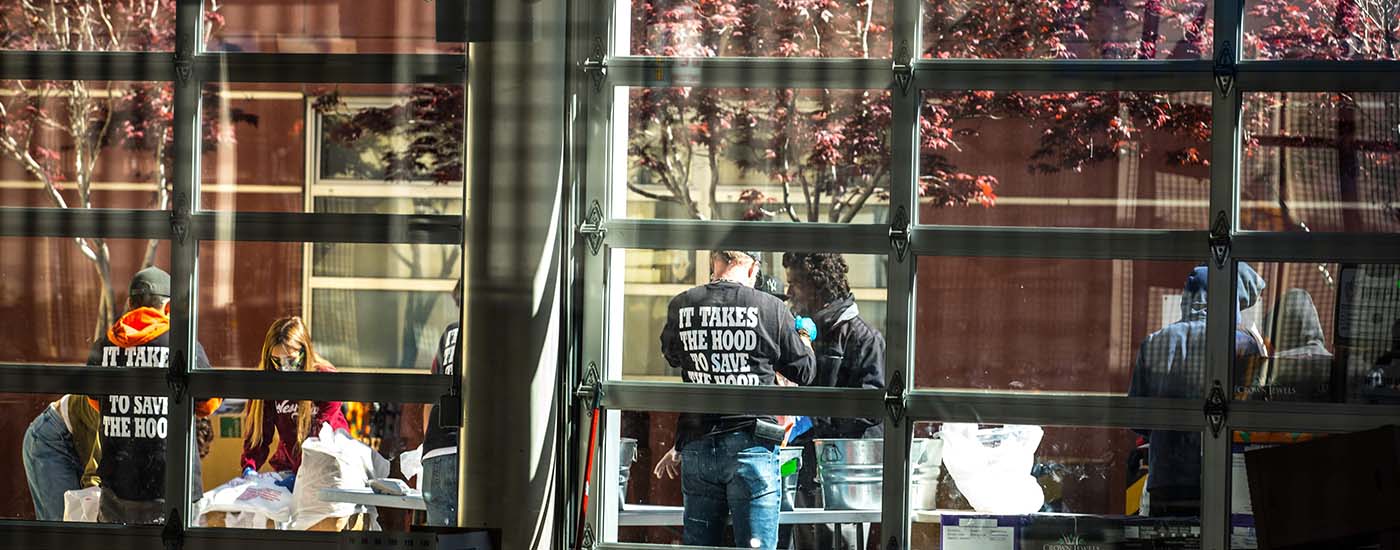
We recently had the opportunity to see one of these dedicated partners, United Playaz, in action. Every week, United Playaz, a youth-led violence prevention organization, helps staff the pop-up food pantry at Bessie Carmichael Elementary school. Members of the group not only help pack up and distribute food at the pantry, but they proactively stepped up to deliver groceries to 100+ seniors in their community. These are all seniors 65 and over who used to pick up groceries at our weekly pantries.
We spoke with United Playaz Executive Director, Rudy Corpuz Jr about the group’s support of the Food Bank.
Food Bank: What is your role at this food pantry?
Rudy Corpuz Jr.: We are here because this is our community, we were doing this before the crisis started. We want to make sure we play our part and help out in the community for the most vulnerable population and just provide some support and help to make sure everybody is eating.
FB: Has it been hard to recruit your members during these times?
RC: Absolutely not. You know we want to give back. Our motto is: It takes the hood to save the hood. It’s our way of giving back. We’ve got different community-based organizations that have come together in solidarity under one umbrella, with no pride, no ego, just to make sure we take care of the community and the people.
And all walks of life, you know what I mean. We’ve got ex-convicts, we’ve got college students, we’ve got developers, we’ve got tech people, people who went to school, who didn’t go to school – everybody who wants to help out and put their life on the line for others.
FB: Are you concerned about your health being out here during COVID-19?
RC: Absolutely, of course, I am. I have kids. I want to make sure I’m safe, and my kids are safe, and my community is safe. But I know there is a bigger need. Somebody’s got to do it. And so, what better way…I don’t want to die, or even get sick…but what better way to put your life on the line for others in this way.
FB; Can you tell me a little about how you’ve been helping get food delivered to those who can’t come to the pantry?
RC: During this crisis, everybody knows that the most vulnerable population is the senior citizens. You have a lot of seniors in this neighborhood – South of Market District 6 – who live in their apartments and live in the hotels, the SROs, and they are scared to come out. So, what we do as service providers for the community is to find out what their need is and what they want. We go out there and ask them if they need groceries, which they do, and boom, we deliver it to them.
FB: How are you in touch with these individuals?
RC: In our community, there are already organizations that are working with seniors. We are youth-led and there are senior groups. So what I did, I brought us all together and said, “hey look here, we’re in this crisis together. You know, service providers that serve seniors, we serve kids, some people serve reentries, the Food Bank gives food, let’s all work together in solidarity to make sure we are hitting the most vulnerable population.”
So, the senior organizations will tell us who needs what. We provide the muscle and the leg power and energy, and we go out and do it.
It’s like a basketball team, everybody has to play their part on the basketball court. You have the center who is in the middle and gets the rebounds, you have the guards who bring the basketball up. And so, if everybody plays their part, we’re successful, we win.
During this crisis, these are the times that you have to stand for something that is greater than you. What a greater way to work with the food bank who provides those services. We don’t do it, they do it.
FB: But you are out here making it possible – being the arms and the legs.
RC: But I think that’s what I’m saying. You guys are like bringing up the ball. We get the ball, we put it in the hoop.
Food Bank partners and volunteers like United Playaz are making it possible for us to continue our mission. Sign up to volunteer here.
During this crisis, these are the times that you have to stand for something that is greater than you.
We are all coping and adapting to the new realities of the global COVID-19 pandemic and its impact on our lives. We are learning to balance uncertainty andsocial isolation along with the increasingly challenging practical realities of everyday life
At the Food Bank, we have always known that it takes a strong fabric of community to address hunger in the Bay Area. And as ripple effects of COVID-19 are felt, we have been especially inspired by all the ways – great and small – that our community is coming together to support each other.
Volunteers Stepping Up
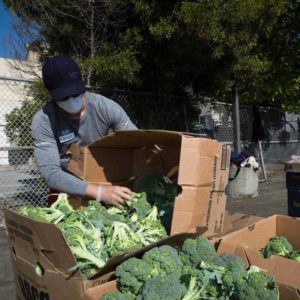
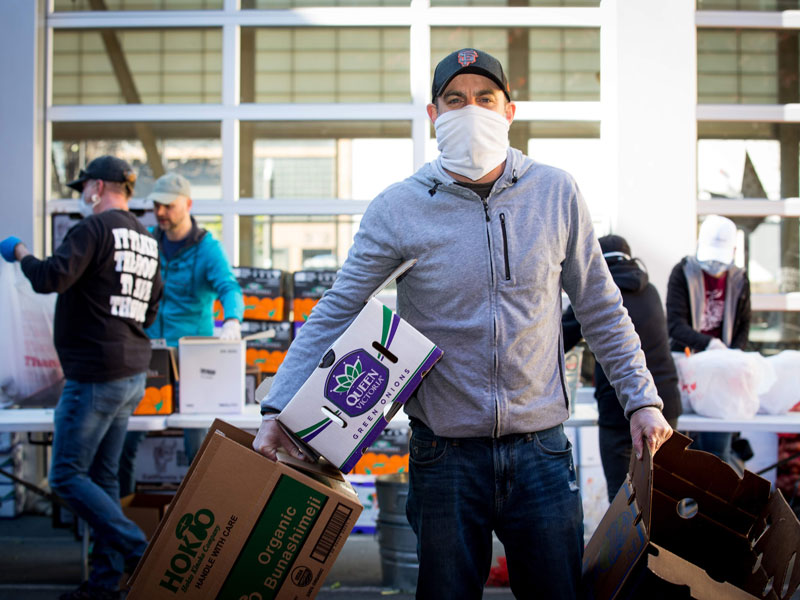
Week in and week out we see countless individual volunteers and partners come out to haul and pack 30-pound bags of potatoes, oranges, onions, and other groceries. Many, like Nate Fahey, who came to Bessie Carmichael Elementary School with his church last week, just want to help the community during these difficult times. “Right now, there is a little extra emphasis on giving back when we can,” said Fahey.
“An hour or two of your life could really help anyone in need right now,” he went on to say. “It doesn’t take much for us to help others.”
Not just individuals are stepping up. We’ve received an outpouring of support from partners and community groups – even county workers from the library system – to fill the gaps. They are driving trucks, packing boxes, and delivering groceries to the homebound. Many of these groups, like United Playaz and West Bay, are stepping up without being asked.
Working Together in Solidarity
After hearing about a need to reach more homebound seniors in their community, United Playaz decided to work with the food bank to deliver food. “We provide the muscle, the leg power, and the energy. And we go out and do it,” said Randy Corpuz Jr., Executive director of United Playaz.
These volunteers pick up groceries, pack up their cars, walk stairs and knock on doors to make contactless deliveries every week.
It’s hard work. And still, they do it.
“During this crisis, these are the times that you have to stand for something that is greater than you,” said Corpuz. “What a greater way than to work with the food bank who provides those services.”
The Food Bank extends a big, heartfelt thank you to all the partners and volunteers who are standing arm in arm with us on the front lines of this pandemic. We couldn’t do it without you!
Partner Spotlight
In honor of the volunteer appreciation month, we will be celebrating and spotlighting our amazing community partners and volunteers throughout the month of April. Each week, we will publish one Partner Spotlight, and we will be sharing more from our wonderful volunteers and partners on social media throughout the month. Check back soon!
In the meantime, if you want to help please sign up to volunteer here.
An hour or two of your life could really help anyone in need right now. It doesn't take much for us to help others."
“It was a logistics miracle,” said Barbara Abbott, Vice President of Supply Chain at the Food Bank, beaming as she walked out of the San Francisco-Marin Food Bank’s San Rafael warehouse on Saturday afternoon.
Abbott and her team had just finished the Food Bank’s first-ever drive-through food pantry. And somehow, besides the rainy weather, the event went off without a hitch.
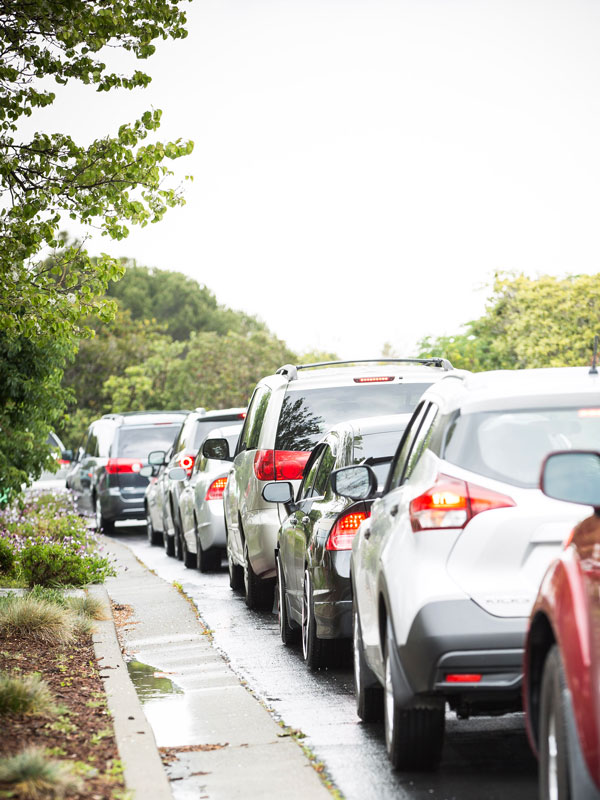
From the moment the pantry opened at 9:45 a.m. until it closed a little after 2 p.m., staff and volunteers loaded 30-pound boxes into cars. The length of the line waxed and waned – at some points even wrapping around the building – but the flow of cars remained steady throughout the day. By the end, we had served more than 600 households – 100 more than expected.
Necessity: The Mother of Invention
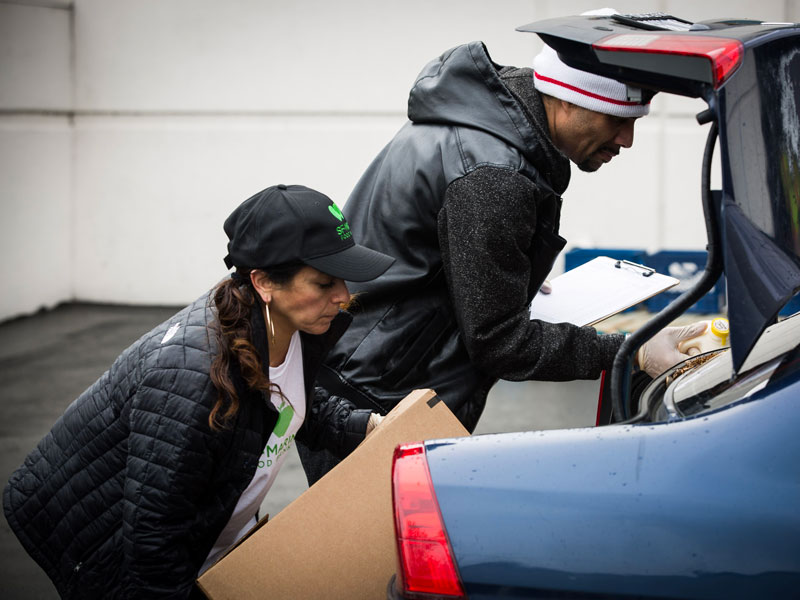
The setup was designed to promote social distancing – something none of us considered before COVID-19. Participants drove up and opened and closed their trunks, so the Food Bank could continue the essential service of distributing food while minimizing person-to-person contact.
Despite how seamless the operation appeared, it wasn’t as simple as it looked. A lot of thought went into the day.
For example, how do you efficiently pack 500-600 boxes while maintaining social distancing? “It’s not easy to keep 20 people away from each other at six feet distancing,” said warehouse manager Steve Coover. “The way we set up was pretty difficult at first. But we finally figured it out and it went smoothly.”
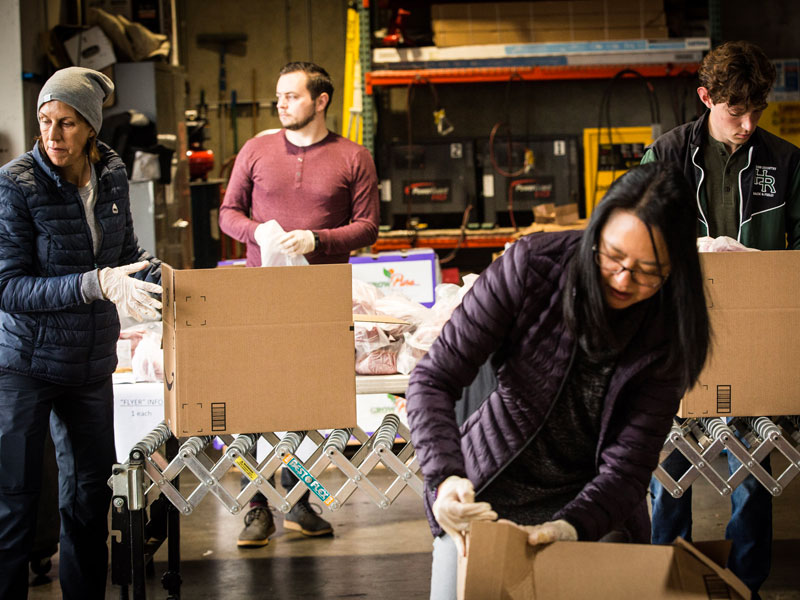
After a trial run on Friday, Saturday looked like a well-oiled machine. A carefully organized assembly line of volunteers slid boxes across a conveyor belt as they loaded in fresh produce, meat, and healthy non-perishables. The process was streamlined and efficient and even the social distancing was a success.
A Team Effort
Katy McKnight, Director of Community Engagement, provided a practical explanation for the team’s success: “We applied best practices we’ve learned over our 30 years delivering food and have been able to bring that here to our San Rafael facility.”
Everyone agreed the logistical success of the drive-through was only possible because of the community support.
“The community is really rallying around us now,” said McKnight. “People have turned up to volunteer, allowing us to run a project like this, and allowing us to pre-box all of these groceries to make it as safe for our volunteers and participants as possible and as efficient for our participants as possible.”
Coover, who spent much of Saturday managing the line of cars and directing traffic heard many participants saying, “thank you, we appreciate you guys being here.”
He was also out there reminding them we’ll be back again next Saturday from 10-2. The San Rafael drive-through, at 2550 Kerner Blvd, will be a weekly operation for the foreseeable future.
For those who want to volunteer, please sign up here. We especially need the support of those who are bilingual.



 Share this quote
 Esther Honda: We started volunteering once shelter-in-place started. I knew I wanted our family to volunteer at the Food Bank, and it just worked out well for us to deliver groceries. I have to confess that it seemed like a good excuse to get out of the house but also felt really necessary to help others who could not safely leave home.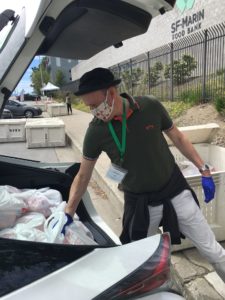
 “I haven’t worked in a month,” said Doaldo, who worked in restaurants before the pandemic. “We don’t have money for food or anything.”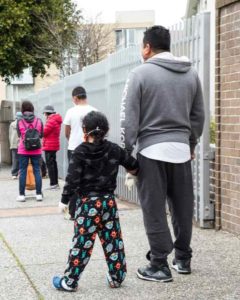
Share