
David’s Story | Security Alert

January 22, 2018

As a security guard in San Francisco, David’s job is to protect life and property.  It’s somewhat ironic that at home, he and his family face another serious threat: hunger.

“My salary is decent,” said the 62-year-old father of three. “But with kids and living in this city, where it’s so expensive, I’m finding more and more that it’s simply not enough.”

High Cost of Living

David’s story is one told all too often in this city.  A recent report from the California Budget and Policy Center finds that San Francisco tops the list of most expensive counties in California when trying to support a family.  For example, a family of four, with two working parents, needs to earn about $111,000 a year to simply cover the basics of rent, food, healthcare, transportation, child care and taxes. Marin County ranks second at $110,000 a year.  Both figures far outweigh what David is taking home in his paycheck.

“My wife is unable to work right now, so it’s up to me to support her and the kids,” he says.  Two of those kids are high school boys. The third is David’s 13-year-old 8th grade daughter, Shreena, who attends James Denman Middle School in the city’s Balboa Park neighborhood. It’s here where he and his family find a little bit of relief. For the past several months, they have been accessing the Health Children’s pantry on campus, picking up a bag filled with fresh produce, protein, and staple grains every week.

David is most impressed with all the fresh produce they are able to get at the pantry. “The kids love all the fruit – the apples, pears, and oranges. I like the fresh vegetables,” he says excitedly. “The best part is that some of the food lasts for several days. Some of the items, like the chicken, I’m able to freeze when I get home and cook it a couple of days later.

A Better Community

In the end, David figures the Food Bank is saving him and his family a couple hundred dollars a month.  With teenagers who are constantly growing out of clothes and shoes, that money seems to disappear quite regularly. Still, it’s a comfort for him knowing that every Thursday afternoon he’ll be able to get a grocery bag filled with healthy food if he needs it.

“Some people say that it’s a waste of time to help the people of this city who can’t afford to feed themselves. I say that’s not right,” David says. “We are all making this community better in our own way, and it’s important to protect that.”
Heather’s Story | Young Marin Family Grateful for Pantry Food

November 23, 2017

Life’s not perfect – far from it at times – but you won’t hear Heather complaining about it too much.  She would much rather spend her time counting her blessings, like the time she spends with her two young children and her fiancé.  Unfortunately, sitting down for a family meal is a rarity these days.

MAKING ENDS MEET

Heather wakes up before dawn each morning so that she can get to work stocking candy machines at 5 am. She puts in a two-hour shift, then returns home, so her fiancé can leave for work. He has two jobs as a cook and works six days a week, twelve hours per day.

They hardly see each other, but it’s the only way the family can scrape by to pay the high cost of rent. Heather depends on the Food Bank pantry at the Ritter Center in San Rafael to feed her kids. “This is a life changer, and I think this place is keeping us alive,” she says. “It’s where I get the fresh fruits, vegetables, and eggs that make up most of our food.”

This time of year is particularly hard time for Heather’s family because both the kids’ birthdays are in November and then Christmas is right around the corner. She wants to provide them the happiness of opening gifts. “I get them toys at the Goodwill,” she says. “They are young so they don’t know that they are used.”

FOOD BANK SUPPORT

No matter the situation, the Food Bank is ready to respond to the needs of participants, especially during the holidays.  We served fresh, nutritious food to over 32,000 households during the months of November and December of last year, and are on pace to top 33,000 households this year.

In spite of her hardships, Heather keeps a positive attitude. “When I look at our finances, it’s so stressful,” she says. “But life is too short, and I’m thankful for what we have. We aren’t going hungry, and I’m grateful to the Food Bank and its supporters for that.”

You can ensure that families like Heather’s have enough to eat everyday by making a cash donation to the Food Bank today.

Rosetta’s Story | Thanksgiving with the Family

October 25, 2017

When Rosetta was growing up in San Francisco, she was one of five children. She always looked forward to Sunday dinner because that’s when her daddy cooked. “He was the best cook in the neighborhood,” she said.

At Thanksgiving, Rosetta’s father would cook up a storm, somehow squeezing dozens of family members and friends into their small home for a festive holiday meal.

When Rosetta got older and had three sons of her own, she always felt that providing healthy, nutritious food was critical. Buying enough food was no big deal while she was married and working as a nurse.

However, when she was 40, Rosetta divorced and became disabled. Overnight, her monthly income was slashed in half, and she struggled to feed her sons.

“I worked so hard to keep my boys out of trouble,” said Rosetta. “The best way to do that was football. But they really did eat me out of house and home.”

Rosetta started attending the food pantry at her local church, where she picked up fresh produce and other groceries to nourish her children. Today, the church is one of the Food Bank’s 253 neighborhood pantries.

“Financially, the Food Bank saved me,” said Rosetta. “It allowed me to give my children the nutrition they needed to play sports. It’s those sports that kept them out of trouble.”

Today, Rosetta’s sons are all grown up and working hard to support their own families. At Thanksgiving, they’ll all come together. Rosetta will bring steamed greens she’s harvested from her small garden. Saving the ends of vegetables she receives from the Food Bank, she roots them in water, and then plants them in a tidy plot outside her apartment.

“This Thanksgiving, when I’m feeling gratitude for my family, I’ll also be feeling gratitude for the Food Bank for helping me feed my family healthy food,” said Rosetta. “The people who give to the Food Bank are like guardian angels.”

You can be a guardian angel for Rosetta and other neighbors in need by making a donation today.

Food Bank Response | North Bay Fires

October 11, 2017

Updated Sunday, October 15

As massive wildfires continue to decimate the North Bay, causing thousands of people to flee their homes, Bay Area Food Banks are responding. We have been working together all week to provide emergency food assistance to displaced neighbors. Our hearts and thoughts are with our North Bay neighbors who are seeking support.

Need food? Marin food pantries welcome fire evacuees: If you or someone you know in Marin has been impacted by the wildfires (and is not already receiving meals from an evacuation center), food is available from the Food Bank’s pantry network. Click here to use our Food Locator tool to find weekly food pantries that are open in Marin. To help individuals and families recover, the San Francisco-Marin Food Bank is making emergency food assistance available to evacuation centers and encouraging new participants to enroll at our weekly pantries.

Want to help? Monetary donations are the most effective way to assist right now.  

> Donate here to support Redwood Empire Food Bank,which is in the middle of the disaster zone, serving Napa, Sonoma, and Mendocino Counties. 

NOTE: At this time, the San Francisco-Marin Food Bank is not accepting donations of food, water, or other supplies. Get updates and stay connected with news about how San Francisco-Marin Food Bank is supporting the wildfire recovery efforts by following us on Facebook and Twitter.

How San Francisco-Marin Food Bank is supporting relief efforts

In times of emergency, Food Banks play a key role as “second responders,” providing food and water in the immediate aftermath of disaster, as well as longer-term food assistance as neighbors rebuild their lives.

At the San Francisco-Marin Food Bank, our Food Resources and Operations teams sprang into action early last week, assembling 12 pallets of shelf-stable snack items, drinks, and peanut butter. These ready-to-eat foods are being delivered to shelters that are housing people displaced by the fires.

On Tuesday, we moved those pallets of food to our Marin warehouse, which is much closer to the fire lines, and much closer to the people who need it. Within hours of arriving in Marin, two pallets were delivered to an evacuee shelter in San Geronimo Valley in West Marin County, helping 30 people who were forced from their homes the day before. Other shelters are opening daily, and our emergency-relief food is close by, ready to be shipped out as soon as it’s needed.

This weekend (October 14-15), we are providing food for breakfast for 400 evacuees at the Marin Civic Center evacuation shelter. The 11 pallets of food delivered today include cereal, peanut butter, jelly, beverages, apples, and pears.

Our team has also delivered a truckload of food and water to the Redwood Empire Food Bank (REFB), which is in the middle of the disaster zone, serving Napa, Sonoma, and Mendocino Counties. We have also sent four of our skilled forklift operators to help out at the REFB warehouse this weekend. Four members of our warehouse team – Rich, Steve, Leonardo and Carl – will travel to Sonoma County to provide assistance.

In the news, San Francisco-Marin Food Bank was featured on KTSF-Channel 36 TV (Chinese language). Click here to view the 3-minute segment; we are mentioned at the 1:43 mark.


Military Fights Hunger During Fleet Week Visit

October 5, 2017

The battle against hunger in San Francisco and Marin really heated up this month when active-duty members from the U.S. Marines Corps and the U.S. Navy stopped by the warehouse for a volunteer shift as part of the 2017 Fleet Week celebration in the Bay Area.

These men and women in uniform rolled up their sleeves (literally) and helped bag thousands of pounds of frozen corn.

Check out their visit in this video produced by the Marines:

Lance Corporal Christine Carter told KCBS Radio that her job in the Marines centers on combat logistics. Her role at the Food Bank was something a little easier, but still vitally important to the community. Listen to KCBS Radio reporter Jenna Lane’s story:

The visit was all part of the community work carried out by the military during the annual Fleet Week celebration in the Bay Area.  This was the fourth year in a row that uniformed volunteers  descended on our warehouse for active-duty food packing.

When it was over, the Marines and Navy personnel had managed to bag 2,800 lbs. of corn, just in time for it to be trucked out to the 250 food bank pantries this week and next. Mission Accomplished!

Click here for more information about how YOU can volunteer your time at the Food Bank.

Monet’s Story | CalFresh Helps Busy College Student Thrive

September 22, 2017

Monet is a full-time student at San Francisco State with a double major. She’s got dreams of starting a nonprofit to help inner city youth overcome their challenges as she once did.

From the time she was 13, Monet took care of her two younger brothers as her divorced parents struggled to put food on the table. She attributes those responsibilities to her motivation to succeed today.

“We all need to survive,” says Monet. “But we can’t just set up camp in our struggle. We have to strive to do better.”

Right now, Monet juggles a full class load with a full-time job to put herself through school. But with the skyrocketing cost of housing, she has trouble making ends meet.
“Sometimes I thin out my food and eat just rice to pay for basic necessities,” she says. “And I don’t have any money to put in my savings for emergencies.”

Enter the CalFresh Outreach Team, which recently helped Monet secure CalFresh (food stamps) as well as connect her to our pantry at SF State. In addition to food distribution, the Food Bank also works to ensure that people are able to take full advantage of the federal food assistance programs available to them. With CalFresh, Monet can buy food at her regular grocery store and supplement what she gets there with fresh produce and staples from the pantry located on her campus.

“Hunger should never stand in the way of a student’s education,” said Francesca Costa, CalFresh Outreach Program Manager. “By helping Monet and other students focus on their studies instead of where their next meal is coming from, we are investing in their success in school and in life.”

Monet said that the Food Bank helped lift a weight off her shoulders. Wise beyond her years, Monet views her situation as an opportunity: “It’s challenging to survive on my own. But it brings growth.

“Taking care of myself financially, mentally, being on top of school, and being on time for work is a lot. But receiving food has helped, so I don’t have to worry about where I’m going to get grocery money. I’m so grateful for the Food Bank.”

Click here to learn more about CalFresh and how you can sign up for benefits.

Click here to read about our College Pantries.

Take Action

Right now, the Supplemental Nutritional Assistance Program (SNAP – called CalFresh in California)  is at risk of federal budget cuts. Will you take just a minute to add your name to our letter to our California legislators, urging them to protect and defend funding for SNAP? Click here to add your name.

Over 60,000 people in San Francisco and Marin Counties rely on the to buy food for themselves and their families each and every week. Without the SNAP program, low-income neighbors, who are already struggling to make ends meet, would go hungry.

2017 Community Partner Honoree | Gary Maxworthy

September 19, 2017

After spending much of his adult life leading a Bay Area-based food distribution company, Gary Maxworthy suffered through a tragedy.  It was 1994, he was 56 years old, and his first wife died.  As the grief slowly began to subside, Gary’s three children came together and suggested a change.  They wanted him to do something with his life that would strengthen his community.  Gary agreed and soon joined AmeriCorps as a VISTA volunteer. His first and only assignment was with the San Francisco Food Bank. His mission: to think of ways to address the growing problem of hunger.

This was at a time when food banks were distributing mostly boxed and canned non-perishable foods.  Gary had an inkling of an idea that not only would increase the amount of food we distributed, but also to provide tons of fresh, healthy produce for our participants.  He started reaching out to his old food distribution contacts – growers and packers up and down California – and asked if they would be willing to donate their extra produce to the Food Bank.  The initiative was called Farm to Family.

Eventually the idea took off.  Now, nearly two decades later Farm to Family serves a statewide network of 43 food banks, providing 180 million pounds of fresh produce every year.  Six-hundred thousand Californians are nourished by this food every week.  Just last year, Farm to Family delivered its one billionth pound of fresh produce!

While Farm to Family would be enough to make someone a “Food Hero,” Gary went beyond all of that.  He has been revered for his innovative spirit, his leadership, and his mentoring of Food Bank employees.

Gary announced his second retirement earlier this year, but before he could ride off into the sunset, he was chosen as the San Francisco-Marin Food Bank’s 2017 Community Partner Honoree for his incredible legacy and contribution to food banking, not just locally, but around the nation.

Watch Gary’s tribute video above.  And listen to Gary, in his own words, in this recent KQED Perspectives piece.

Food Bank Innovations | Food Pharmacies

August 9, 2017

He’s really not one to gloat, but for the first time in a long time 39-year-old San Francisco resident Julio says he’s feeling healthy.

“I’m hoping to live a long life for my two kids and my infant granddaughter, and I have the Food Bank to thank for that.”

Julio has “pre-diabetes” which means if he doesn’t start making changes to his diet, he’s a candidate to develop Type 2 Diabetes. His doctor recently referred him to the Silver Avenue Family Health Clinic, in the city’s Visitacion Valley neighborhood. There, the Food Bank and the San Francisco Health Network (SFHN) partnered this year to open up a new program centered on healthy, nutritious food called Food Pharmacies.

Julio says he came in weighing more than 270 lbs, and a blood pressure reading of 190 over 102. Several weeks later, and he’s dropped a few pounds, and saw his blood pressure drop considerably. “I finally feel like I’m on the right path to good health.”

Alicia Hobbs organizes the program at Silver Avenue and says the idea is to use food as medicine in a new regimen aimed at patients with health challenges, such as diabetes and hypertension. “We’re not just introducing patients to healthy food…we’re teaching them how to cook this food in the healthiest way possible. Perhaps most importantly, we’re trying to create a community where these patients feel supported every step of the way.”

Along with the food, patients have access to weekly health screenings, one-on-one consultations with Registered Dietitians, and referrals to additional resources like CalFresh.

James Stancil helps coordinate the Food Pharmacy and is also a patient. “I’ve been on the program for several weeks now, and I can tell you that I’m now being taken off of some of my meds.  My health has improved that much…this program is definitely going to save some lives.”

UCSF Clinical Professor, Dr. Rita Nguyen is overseeing the program for the SFHN and says “Addressing these barriers is key to the Network’s priorities of delivering high-quality care for diverse populations and addressing health disparities. Clinic staff and patients have been really enthusiastic about this new programming which would not have been possible without our wonderful partnership with the San Francisco-Marin Food Bank.”

Food Bank Director of Programs, Sheila Kopf couldn’t be happier to be partnering on such an innovative new program. “Good nutrition is essential for good health, and by working with these health care providers, we are building connections for patients to food assistance, which can improve their health outcomes for years to come.”

The plan is for the Food Bank and the San Francisco Health Network to open up five more Food Pharmacies in the city by the summer of 2018 and serve more than 200 patients.

We never stop innovating!  Support our Food Pharmacies and other new programs by donating today.


Healthy Children | Monday is Pantry Day

July 28, 2017

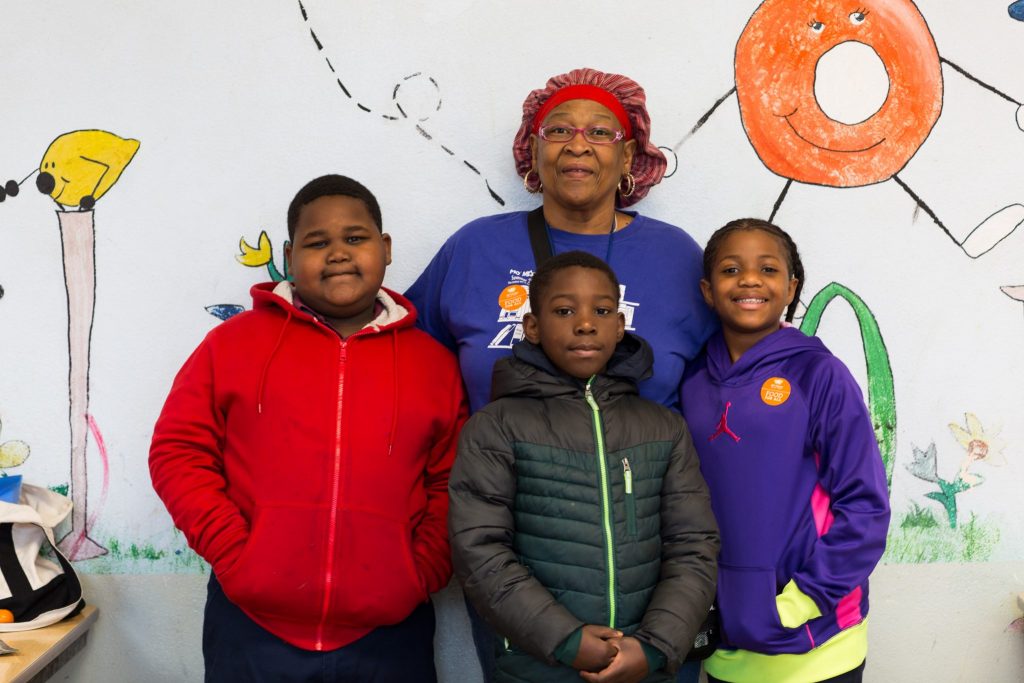
Later this month, it’s back to school for thousands of children all over the Bay Area.  A great many will likely groan when they hear the “Brapp! Brapp! Brapp!” of the alarm clock, but 9-year-old Za’niya is quite the opposite.  The incoming fourth grader at John Muir Elementary School in San Francisco actually looks forward to getting up early – especially on Mondays.  You see, Monday is pantry day at her school.  It’s when Za’Niya rises at 6am and helps her Great Aunt Jeanette, and her two cousins, Jayden and Jamire, set up the Healthy Children Pantry in the school’s cafeteria. Serving about 50 families every week, John Muir is one of 46 schools in San Francisco and Marin that partner with the San Francisco-Marin Food Bank to host pantries for students and families throughout the school year.

“Six o’clock is kinda early, but it’s okay because I know we’re helping out a lot of people who don’t have enough food at home to eat,” says Za’Niya, as she maneuvers a box of produce on a table in the school’s multi-purpose room.

Za’Niya is partial to the apples that find their way to the pantry: “They’re sweet and I really like it.  I put them in my backpack or my jacket pocket and eat it at recess.”

Jeanette has volunteered as the pantry coordinator for a few years, motivated by the need she sees among the families who attend John Muir. Almost 90 percent of the students are eligible for the free and reduced-price lunch program.

Now that she’s retired, Jeanette finds it increasingly difficult to stretch her budget to cover living expenses. “It used to be that I would pass on taking food from the pantry. I would leave it for other families because I felt like they needed it more,” she says. “But now, I’m finding that my own Social Security checks aren’t covering all the bills. My family is also struggling, so I take a box of food from the pantry too – some for me, but mostly to make sure Za’Niya and her cousins have good food to eat at home.”

For busy families, accessing fresh, healthy food right on campus, just before the bell rings on Monday mornings, is a great help.

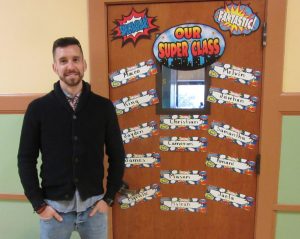
Ryan Lawler, Kindergarten teacher says, “It’s hard for a lot of our families; some work two or three jobs. They’re trying to get their kids ready in the morning, to get them on the bus, to get them here to school on time. So with the pantry right here at school, our parents have a convenient, reliable source of food to sustain their families all week long.”

Last year, about 4,000 families were served by Healthy Children Pantries like the one at John Muir Elementary. These farmers’ market-style pantries provide low-income parents with fresh fruits and vegetables, lean protein such as chicken or eggs, and pantry staples like rice and beans.

Please give today to help parents provide their children with the food they need to stay healthy and thrive.


Home-Delivered Groceries | Food & Friendship Door to Door

June 12, 2017

For many of our most vulnerable neighbors, food is more than the difference between an empty plate and a full stomach. It is also a lifeline – especially for neighbors who participate in the Food Bank’s Home-Delivered Groceries (HDG) Program.

For a closer look at the Home-Delivered Groceries program “in motion”, check out this video, taken at City Hope Community Center in San Francisco’s Tenderloin neighborhood, featuring a beloved participant by the name of Susan who is visually impaired.

Then there’s the story of Marianne, who says the weekly delivery of fresh groceries she receives from the Food Bank is a life saver. She lives in a single-room-occupancy (SRO) hotel in San Francisco’s SOMA neighborhood and struggles with many health challenges.

“I’m disabled and have a hard time getting around, so being able to get my hands on this food at home is literally saving my life,” she said.

Before enrolling, Marianne recalls it was a constant battle to get enough food to eat.  “I couldn’t feed myself. Thankfully neighbors would offer me meals every once in a while. But there were days when it was really scary just how hungry I was.”

Marianne is one of 1,400 people enrolled in the Food Bank’s Home-Delivered Groceries Program, which assists low-income seniors and adults with disabilities who are unable to get out to pick up groceries, but still able to prepare meals for themselves.

The goals of the program are to provide supplemental nutrition to neighbors in need, to reduce loneliness, and to check on the well-being of our homebound residents.

HDG Program Director Andy Burns recalls one volunteer who had been delivering groceries to a senior for more than a year.  “Of course she’s performing a check in with this gentleman each week to make sure he’s doing okay.  At one point, the volunteer became ill, and had to be hospitalized.  While she was recuperating, the participant became so concerned for her that he started calling her to check on how she was doing!”

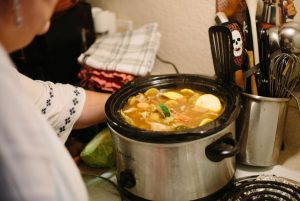
On this particular Tuesday afternoon, the knock on Marianne’s door comes right on time, as she is busy preparing a crockpot stew and needs fresh carrots to make the meal sing. In addition to carrots, this particular delivery included apples, chicken, rice and other staples that will nourish Marianne until her next weekly delivery.

Home-Delivered groceries are also a treat for the volunteers on Marianne’s route – a team of developmentally disabled adults who are enrolled at the Pomeroy Recreation and Rehabilitation Center, where they learn work and life skills. On Tuesday mornings, the volunteers work together to pack these grocery bags, then they head out in the afternoon to make deliveries to 13 neighbors.

Pomeroy’s LouBee Zielinski coordinates the program and says the volunteers are thrilled to help. “They love the looks on peoples’ faces when the groceries arrive. And, to be empowered with something like providing food for others – that’s huge.  It’s like Christmas every week, and we get to be Santa Claus!”

In addition to the Pomeroy Center, there are eight other nonprofits which partner with the Food Bank’s HDG Program, but more partners are needed. For more information on our Home-Delivered Groceries program, how it operates, and how you can get involved, click here.