
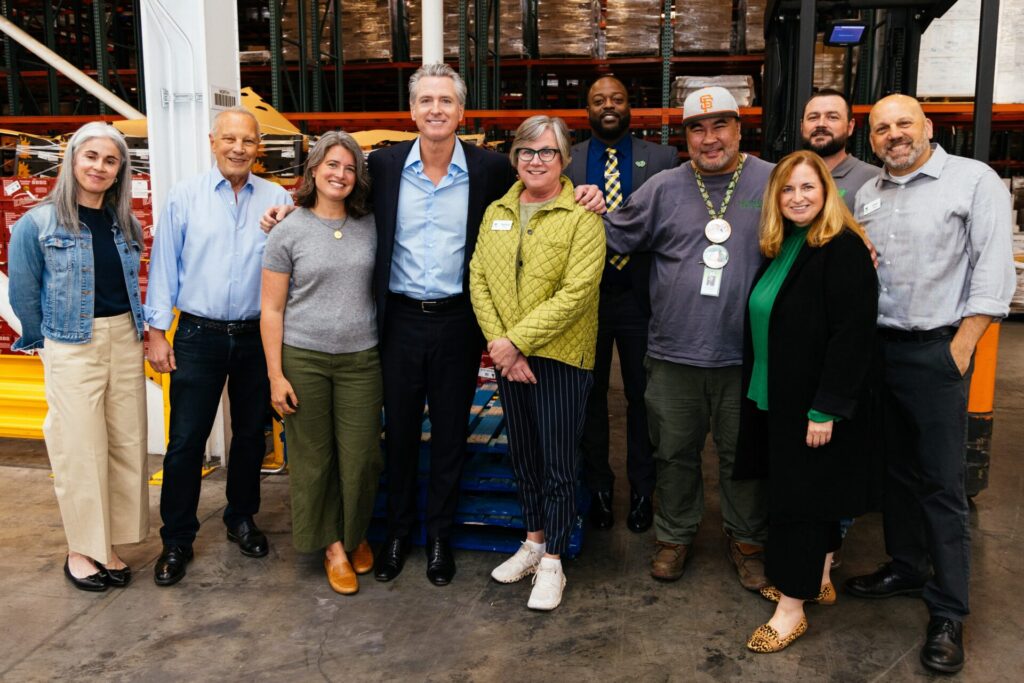
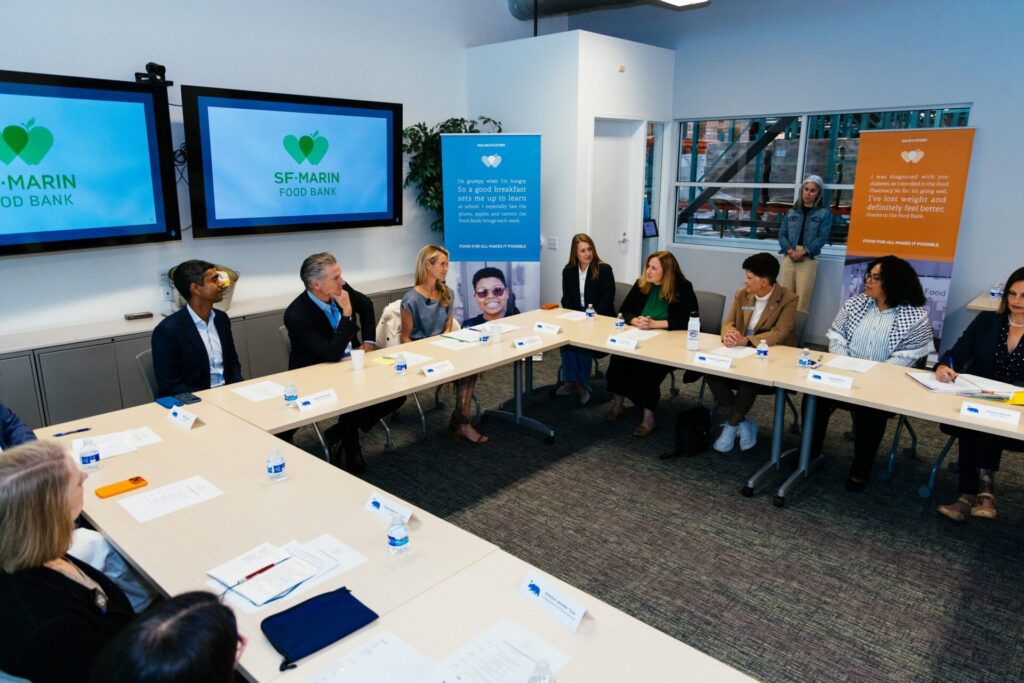
 On October 8, Gov. Gavin Newsom visited the San Francisco-Marin Food Bank to mark one of the biggest CalFresh wins in the Food Bank’s history.
As of June 1, 2026, nearly 350,000 college students at every public community college, California State University, and University of California campus are newly eligible for CalFresh.
“We can’t expect students to learn if they’re hungry, and in California, there is no reason for them to be, whether they’re in kindergarten, high school, or college,” said Gov. Gavin Newsom. “You shouldn’t have to jump through hoops to get the food benefits you’re entitled to, and now you don’t have to.”
One less hoop
The Food Bank championed the advocacy that made it happen, unlocking over $400 million in new annual CalFresh benefits for students.
For years, students had to clear extra hurdles to qualify for CalFresh that no one else faced, including working at least 20 hours a week. Now, associate’s and bachelor’s degree programs at California’s public colleges and universities count as job-readiness programs, which means financially eligible students enrolled at least half-time can begin qualifying simply by being enrolled. They still have to meet the same income and immigration rules as everyone else.
“It means that there’s one less hoop for undergrad students to jump through,” said Adrian Tsang, the Food Bank’s Bilingual CalFresh Outreach Supervisor. For a student, CalFresh can mean up to $306 a month for groceries, money that frees up a tight budget for rent, books, and everything else.
 Why it matters
Students aren’t who most people picture when they think about hunger. Horace Montgomery, a San Francisco-Marin Food Bank board member who helped found Gator Groceries, the student food program at San Francisco State University, has seen who actually turns up.
“There are athletes, there were folks that lived in housing, there were people who we thought were taking care of,” he said. “They end up being our biggest customers.”
The Food Bank has spent years working to close that gap, because ending hunger means changing the systems causing it.
“No student should have to be hungry to earn a degree, and the students most impacted are communities of color,” said Tanis Crosby, Executive Director of the San Francisco-Marin Food Bank. “That’s a policy choice, and thanks to the Governor and the Breakthrough Project, it’s changing. Thousands of California students can now access CalFresh, so they can focus on their degree instead of their next meal.”
Eligible isn’t the same as having food on the table
Being newly eligible for benefits is not the same as having food on the table. That’s why the state has also launched Full Cart, a statewide outreach campaign to let students know about CalFresh and encourage them to apply now. The Food Bank is doing its part with a new CalFresh Ambassador Program, which trains students and community members to guide their peers through the application, in their own languages and from their own experience. Our CalFresh Outreach team plans to partner with City College of San Francisco, College of Marin, and San Francisco State University to recruit, train, and support student leaders.
Elsy, a San Francisco State student, worked two jobs to make ends meet while in school and leaned on CalFresh to put food on the table.
“It was just such a comfort to know that I could afford groceries, and healthy groceries like that,” she said at the Governor’s roundtable. “It felt humanizing to be able to walk into the grocery store and just be able to buy normal things like kale without thinking about if it’s going to break my budget.”
She knows what this change will mean for the students coming up behind her.
“I’ve had friends who are struggling financially but couldn’t qualify for CalFresh because of their student jobs on campus, where they were scheduled just under 20 hours [the old work requirement for CalFresh eligibility],” she said. “I know this is going to be such a relief, not just for them, but for incoming generations of college students.”
Food is one less thing a student should have to worry about, and for hundreds of thousands of them, it no longer has to be. If you think you might qualify, your campus Basic Needs Center or the Food Bank’s CalFresh team can help you apply, or you can start at BenefitsCal.com.
Share