
Food Safety Net Remains Intact

December 15, 2016

Many of our partners, colleagues, and clients have expressed concerns that proposed changes by the incoming federal administration will change access to safety net programs – including food assistance — that so many in our community depend on.

On November 21st, 2016, the City and County of San Francisco released a statement affirming that at this time, there are absolutely no changes to any of the vital programs administered by the SF Human Services Agency, including CalFresh and Medi-Cal. Marin County released a similar letter on December 6th, affirming its commitment to serving all residents of Marin through these vital programs.

Read the full statement from Trent Rhorer, Executive Director of SF-HSA .
Read the full statement from Grant Colfax, Director of Marin-HHS.

In the coming months and years, we may call on our community to join us in protecting these crucial programs. For now, the San Francisco Human Services Agency, the Marin County Department of Health and Human Services, and the San Francisco-Marin Food Bank remain open for business as usual.

Additionally, San Francisco has affirmed that it will remain a Sanctuary City, meaning that law enforcement will not assist in the deportation of undocumented immigrants. As always, receiving CalFresh and/or Medi-Cal will not impact anyone’s immigration status or future prospects for gaining permanent legal status. Marin County also passed a resolution on December 13th, expressing the County’s commitment to protecting the rights, freedoms and interests of all members of Marin County.

The California Department of Social Services (CDSS) has also released this All-County Information Notice instructing all California counties to assure low-income immigrants that receipt of CalFresh nutrition benefits, or other programs that do not give cash, will not impact their immigration status.

For more information about receiving CalFresh and Medi-Cal as an immigrant, click here: English/Español/中文/Tiếng Việt/русский.

The Steep Cost of CalFresh ‘Churn’

December 15, 2016

Up to $1.16 million lost each year in SF and Marin due to CalFresh ‘recertification churn’

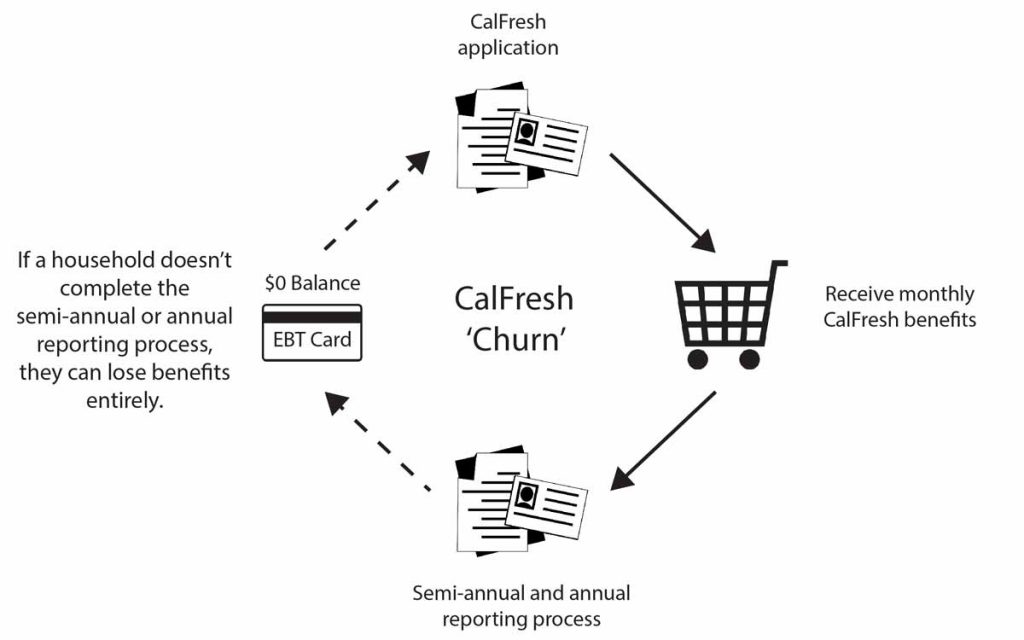
CalFresh recertification churn hurts far too many of our most vulnerable neighbors.  Collectively, they are losing out on thousands of dollars of food assistance:  we estimate that in San Francisco and Marin, upwards of $96,503 in CalFresh dollars are lost by participants each month due to recertification churn.[1]  Recertification churn happens when households do not complete the recertification process (“RRR”) at the one-year mark, only to re-enroll in benefits within 3 months.

In a year, that’s $1.16 million in CalFresh dollars.  When we look at the potential impact on our local economy, the number is even greater – $2 million in lost economic activity over the course of a year.[2] This report found that the administrative costs of recertification were anywhere from 1/2 to 1/3 the costs of processing an initial application. If it takes only 5 minutes more to complete the new applications compared to processing the recertification for those that reapply within 30 days, the added workload would be 100 hours per month.

For neighbors who are struggling to make ends meet, staying enrolled in CalFresh can be a big challenge. In San Francisco County, 25% of people with an RRR due fail to complete it and do not receive benefits the next month. In Marin County, that number is much higher, at 41%.

When counting the losses as missed meals, the numbers are even more alarming. Taking only those cases that reapplied within 30 days and calculating the loss of CalFresh benefits for them at the average benefit rate, San Francisco and Marin are missing out on about 32,000 meals per month. Over a year, that’s almost 400,000 meals.[3]

Two counties that appear to be doing a good job of keeping people continuously enrolled on CalFresh through their RRR process are Tulare and Fresno. In both counties, about 85% of households that have an RRR due are still receiving benefits the following month, compared to 59% and 75% in Marin and San Francisco respectively.

Next week, we will explore why churn is so common and what aspects of the recertification process make it so easy to fall off.

In case you missed it, learn the basics about CalFresh Churn in last week’s blog post.


[1] These estimates assume that each household that did not receive benefits in the month following their recertification but then reapplied within 30 days lost a month’s worth of CalFresh benefits at the average benefit level for that county. Those that reapplied in 60 or 90 days are not included in this calculation.

[2] California Food Policy Advocates, ‘Lost Dollars, Empty Plates’ (2014)

[3] It is worth noting that benefits lost due to churn following semi-annual reporting are not captured here.


CalFresh ‘Churn’ Means More Missing Meals in SF and Marin

December 1, 2016

CalFresh – known nationally as SNAP and formerly as ‘food stamps’ – is a cornerstone of our food safety net in California. Almost 4.5 million people participate in CalFresh statewide, and more than 60,000[1] people participate in San Francisco and Marin combined. CalFresh participants receive an “EBT card” – which functions like a debit card that gets replenished with CalFresh benefits each month; participants then use CalFresh benefits to buy food in grocery stores and farmers’ markets.

Unfortunately, CalFresh churn is a big problem among many recipients.

Churn is when an eligible recipient unexpectedly loses CalFresh benefits, usually because of missed reporting requirements, only to re-enroll within one to three months.

In order to stay on benefits, CalFresh households must report eligibility information periodically. At six months after initial application, participants must notify the county of any household circumstances that have changed through a form called a SAR 7; at one year, they must re-verify all household information and complete an interview. The idea is that household circumstances sometimes change, and having a regularly scheduled time when participants submit documents and verifications ensures their status with CalFresh remains accurate.

But in practice, many households suddenly find themselves with an empty EBT card, unable to buy groceries. Imagine standing at a grocery check-out counter, only to find that your debit card unexpectedly had a $0 balance? What would that mean for feeding your family and paying the rest of your bills that month?

An interruption in CalFresh benefits, even for a month, can have real, damaging consequences for a family that is living on the edge of financial stability. For example, a household with the average CalFresh benefit of $304 per month would lose about 100 meals during the month when benefits are interrupted.

Statewide, one in five Calfresh applications received is from someone who was on CalFresh in the last 90 days.

Why does this happen? Confusion about the semi-annual reporting process, difficult-to-read letters from the county, language barriers, a missed interview, or a recent change in address or phone number can all result in benefits being terminated. It is not difficult to imagine a situation in which a busy family with multiple jobs, hectic schedules of school and childcare, combined with the stress of paying bills and keeping household paperwork in order, could end up missing CalFresh deadlines. Once benefits have been lost, households sometimes have to reapply for benefits all over again.

In addition to hurting recipients, CalFresh churn is inefficient and troublesome for county administrators. Instead of helping new clients enroll or improving the program overall, workers spend valuable time completing new applications for cases which should never have been discontinued in the first place.

We estimate that in San Francisco and Marin, $280,000 in CalFresh money are lost each month due to churn.

Over the next month, the Food Bank Advocacy Team will share a series of blog posts about CalFresh churn. Next week, we will dive into our county-level data in San Francisco and Marin. In subsequent weeks, we will explore more specifically what causes churn, and provide recommendations to diagnose churn and implement effective solutions.

Join us as we explore this topic!


[1] DFA 256 Report, August 2016: http://www.dss.cahwnet.gov/research/PG352.htm
[2] CDSS CalFresh Household Profile, FFY, 2014: http://www.calfresh.ca.gov/PG844.htm

Resource Library

September 27, 2016

Policy & Advocacy Overview

COVID-19 and Food Insecurity

Research and Reports

CalSAWS Advocacy

CalFresh: Data Tools

Partner Organizations and Coalitions

Marin County Resources

San Francisco County Resources